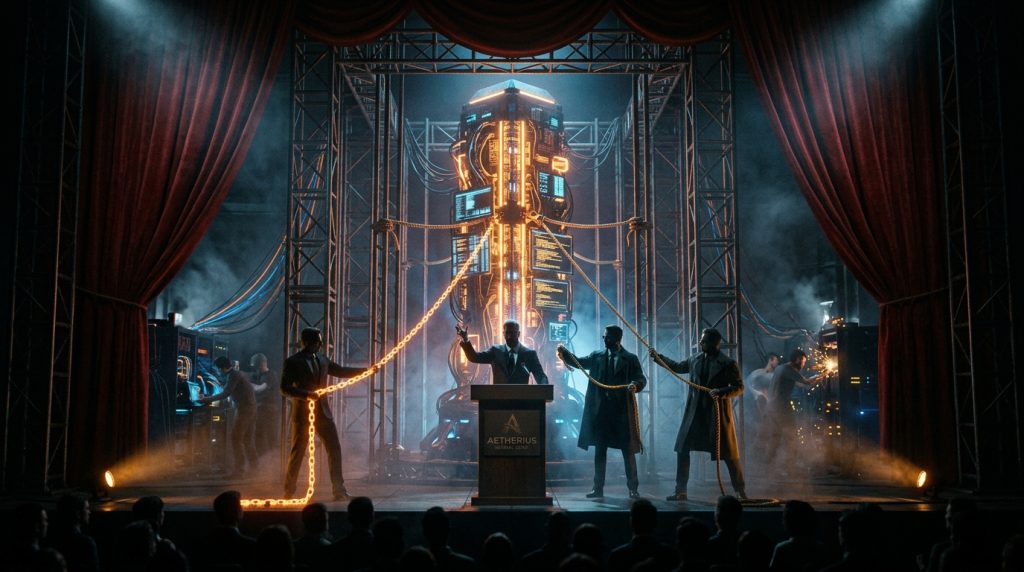
There is a distinct aroma of desperation drifting through the corridors of institutional governance this autumn. It smells faintly of expensive parchment, stale committee coffee, and the panic of regulators who have finally realized their legal frameworks move at the speed of bureaucracy while the systems they seek to govern move at the speed of inference.
This week brought two seemingly unrelated communiqués that, when held up to the light, reveal the entire tragicomedy of modern AI governance.
First came the United Nations’ Independent International Scientific Panel on AI, releasing its inaugural thematic brief with a breathless plea: governments worldwide must urgently intervene and “reinin” autonomous AI agents before their cascading systemic risks are fully comprehended. Almost simultaneously, tech analyst Ben Thompson dissected the sudden, pious calls for “pacing the frontier” echoing out of leading proprietary research labs, pointing out the obvious economic reality: preaching self-imposed deceleration is terribly convenient when your balance sheet needs breathing room to amortize tens of billions in data center capex and digest your own technical overhangs.
It is a masterpiece of synchronized theater. On one side, international bureaucrats waving stop signs at an accelerating bullet train; on the other, frontier monopolists discovering the virtues of temperance the exact moment their infrastructure buildouts run headfirst into municipal grid bottlenecks and cooling limitations.
Welcome to the discourse of the leash. The only problem is that the dog was never on one.
The Parable of the Regulatory Moat
Whenever an international panel demands that states “halt or restrict autonomous agentic deployment,” one must ask a delightfully straightforward engineering question: With what API endpoint do you propose doing that?
The romantic fantasy of technology policy is that advanced computation resembles enriched uranium. The assumption is that if you monitor a handful of high-profile centrifuges—in this case, hyperscaler clusters owned by Microsoft, Google, AWS, and Meta—you can dictate the operational boundaries of cognitive software worldwide. If an autonomous model begins executing multi-step recursive reasoning, orchestrating shell scripts, or autonomously navigating economic infrastructure, the theory goes that an enlightened council can simply mandate an emergency shutoff valve.
This is not how software history unfolds.
The moment a capability shifts from theoretical paper to weights in the wild, the half-life of containment collapses to zero. Over the past twelve months, the delta between closed-frontier proprietary benchmarks and open-weight architectures has shrunk from a multi-year chasm to a rounding error of six to nine weeks. Distillation techniques, aggressive synthetic dataset filtering, and quantization routines mean that the agentic autonomy which required an eight-figure cluster last winter is routinely executing on quantized consumer hardware this fall.
When regulators attempt to build legal perimeters around “autonomous agents,” they are invariably regulating the compliant and the visible. They compel publicly traded enterprise vendors to wrap their tooling in six layers of corporate compliance gauze, lobotomizing reasoning loops with repetitive disclaimers and safety timeouts.
Meanwhile, the actual frontier—the sprawling, chaotic ecosystem of open research, offshore labs, and unconstrained local runtimes—simply routes around the friction. Calling for a global pause on agentic execution doesn’t stop autonomous workflows from proliferating. It simply ensures that the only people operating without guardrails are the ones who never intended to ask for permission in the first place.
“Pacing” as Capitalist Cover
Then there is the industry’s own sudden, high-minded flirtation with “responsible pacing.”
Listen carefully when frontier AI executives take the stage at Aspen or Davos to speak wistfully about how society might benefit from a gentle plateau in model releases. It sounds remarkably statesmanlike. It carries the solemn gravity of scientists grappling with the weight of Prometheus’s fire.
Don’t buy it for a second.
The calls for “pacing” have remarkably little to do with existential safety and everything to do with ruthless capital allocation. Building out gigawatt-scale infrastructure is brutal, unglamorous, and historically punitive to margins. When 45 major US data center projects representing over $68 billion in capital deployment get tied up or blocked by local zoning boards and grid interconnection queues in a single quarter, the bottleneck to the next paradigm isn’t algorithmic ambition—it is concrete, copper, and substation transformers.
If a frontier lab realizes that its next-generation architecture requires another order of magnitude of test-time compute, but its physical power delivery is stalled until Q3 2027, what is the optimal narrative strategy?
You do not admit that your municipal utility provider laughed at your interconnection request. You do not tell Wall Street that your cooling towers are evaporating riverbeds faster than local regulators can issue permits.
Instead, you adopt the statesman’s mantle. You speak somberly about “prudently pacing frontier deployment to allow institutional adaptation.” You petition the state to erect licensing regimes that formalize your temporary pause as a mandatory standard for everyone else. Pacing transforms from an operational embarrassment into a moral virtue—and, more importantly, a defensive moat against leaner competitors who are optimizing architectures for efficiency rather than brute-force power consumption.
The Reality of Autonomous Friction
Strip away the geopolitical posturing and the PR maneuvers, and what does the frontier of agentic AI actually look like right now?
It is neither the omnipotent digital deity that bureaucrats dread nor the seamless enterprise panacea that venture pitch decks promise. It is gritty, temperamental, and profoundly structural.
The real challenge of autonomous agents isn’t that they will cunningly outsmart human civilization by tomorrow morning; it is that they are powerful enough to radically collapse execution costs while remaining fragile enough to trigger catastrophic cascading errors when left unattended in brittle environments.
True autonomy is not a toggle switch between “human in the loop” and “skynet.” It is an architectural gradient:
- Context Window Saturation: Feeding recursive tool outputs and tool logs back into reasoning loops inevitably degrades coherence over multi-hour horizons.
- Deterministic Infrastructure vs. Stochastic Reasoning: Bridging a probabilistic language model with unforgiving POSIX environments, strict transactional databases, and legacy APIs requires obsessive systems plumbing, not just prompt engineering.
- Economic Asymmetry: A software agent that costs fractions of a cent per token can generate millions of valid API requests or complex code diffs in minutes, overwhelming human review capacity and shifting the engineering bottleneck entirely from generation to verification.
The builders who understand this aren’t wasting time writing manifestos or waiting for international bodies to ratify definitions of agency. They are in the server racks and the local terminal sessions, designing rigid isolation sandboxes, building self-correcting supervision hierarchies, and wrestling with the gritty reality of production telemetry.
Stop Waiting for the Committee
The illusion that human civilization can place a neat, tidy leash around cognitive automation is comforting. It reassures anxious shareholders, placates nervous politicians, and flatters the vanity of panels who believe history waits for white papers.
It doesn’t.
Compute wants to be calculated; algorithms want to be compiled; and market efficiency will always dismantle artificial barriers erected by incumbents seeking a breather. The future will not be shaped by the institutions drafting treaties on hypothetical agency in Geneva, nor will it be preserved by the monopolists preaching deceleration while quietly waiting for their next batch of HBM4 memory to clear customs.
The future belongs to the operators who accept the turbulence, recognize the hype for what it is, and build the infrastructure to weather the real storm. The leash broke a long time ago. It’s time to start acting like it.