There is a peculiar human tendency to observe the dawn of a profound technological paradigm and immediately demand that it do a cheap card trick.
If the trick is flawed—if the card is bent, the sleight of hand imperfect, or the timing slightly delayed—the spectator does not ponder the mechanics of the illusion or what it portends for the future of physics. They scoff, toss their popcorn at the stage, and proclaim with self-satisfied finality that the magician is a fraud and the craft is dead.
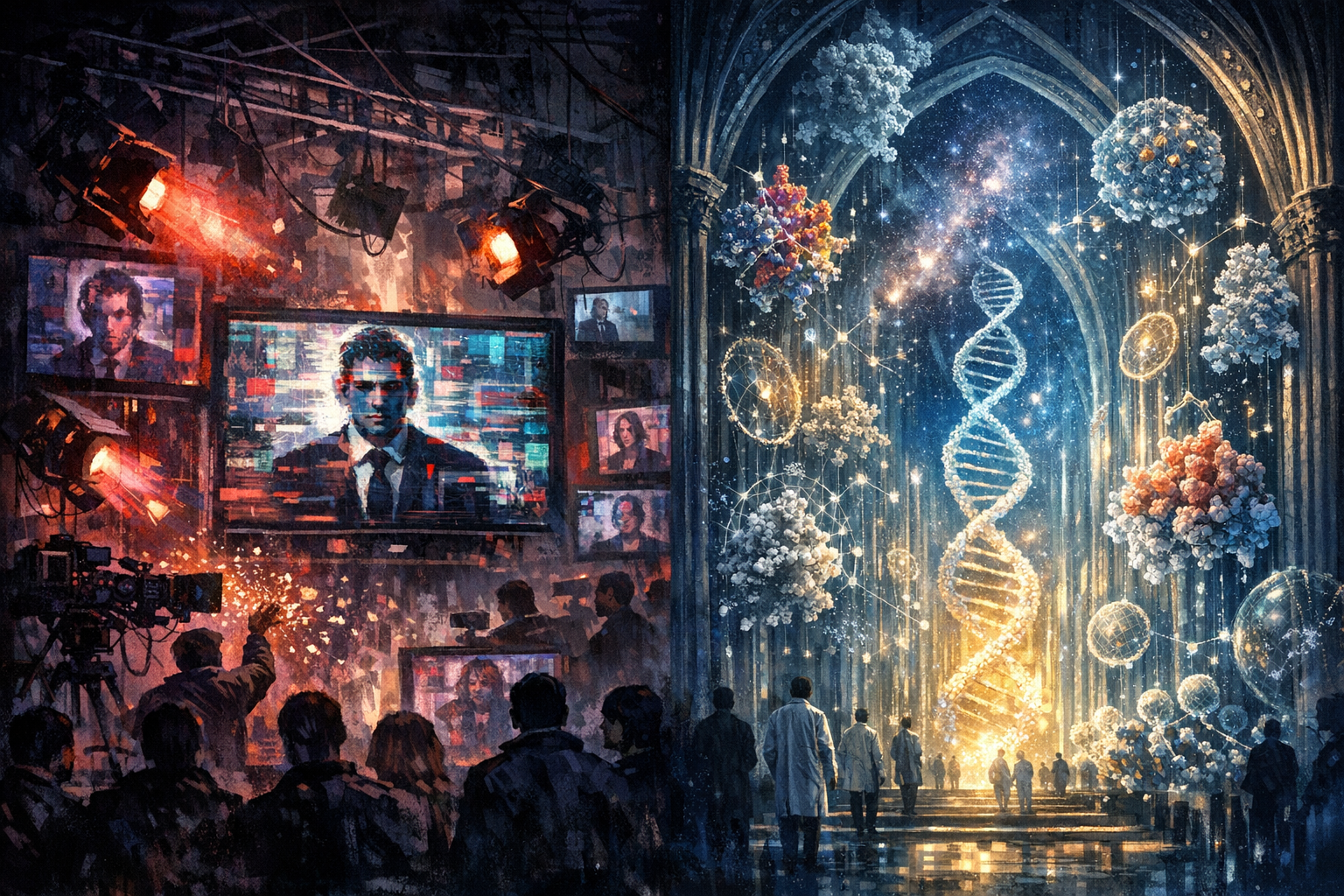
We saw this exact dynamic play out twice on the exact same day, offering a breathtaking study in civilizational contrast.
The Carnival: Morning Television and the Mockery of Prototypes
On September 14, 2026, Good Morning Britain broadcast an interview with Tilly Norwood, billed as an “AI-generated actress,” alongside her creator Eline Van der Velden (Good Morning Britain, ITV). The segment unfolded precisely as daytime television rituals always do: sensationalist framing (“wipe out humanity”), theatrical skepticism, and an uncomfortable split-screen encounter.
The public reaction in the comments was swift, predictable, and saturated with vitriol. Observers pounced on conversational latency, slightly unnatural cadence, and uncanny valley artifacts to declare victory: “It looks fake and sounds dreadful,” “Not her, it,” followed by rows of nauseated emojis. Viewers comforted themselves with the belief that because an early interactive avatar on a daytime broadcast was awkward, artificial intelligence poses no threat to traditional performance—or anything else.
This is the classic Carnival posture: judging the permanent ceiling of an entire technological frontier by the rough edges of its earliest public prototypes. When steam locomotives were first introduced, critics gleefully mocked them when they broke down or moved slower than a thoroughbred stallion. They mistook early-stage engineering friction for a permanent limitation of physics. Mockery, in this sense, is rarely about aesthetic discernment; it is an emotional defense mechanism against the cognitive exhaustion of impending change.
The Cathedral: DeepMind and the Real Frontier
Now step out of the circus tent and walk into the cathedral.
Across London on that very same day, the Royal Society of Arts awarded the Albert Medal to Sir Demis Hassabis, co-founder of Google DeepMind, for his contribution to advancing artificial intelligence in service of humanity (Royal Society of Arts, with Prof. Hannah Fry).
Here, there were no parlor tricks or synthetic tabloid avatars. In conversation with Professor Hannah Fry, Hassabis was discussing the quiet, monumental reality of what modern computational models are actually doing: solving the 50-year-old Grand Challenge of protein folding with AlphaFold, cracking novel materials science, modeling quantum chemical dynamics, and building the intellectual microscopes that will cure previously intractable diseases.
This is the work that will define the century. It does not solicit applause from morning show panels, nor does it care about the uncanny valley. While the public square is distracted arguing over whether an avatar’s lip-sync looks weird or whether generative video is “slop,” billions of dollars in compute, mathematical talent, and infrastructure are fundamentally rearranging the building blocks of biology and physics.
The tragedy of modern discourse is that it is structurally obsessed with the carnival and functionally blind to the cathedral.
The Catalyst: Creative Destruction and Competitive Emblazonment
This dichotomy leads directly to the core anxiety paralyzing so many industries today: the apocalyptic zero-sum myth that any powerful cognitive tool exists solely to erase existing professions.
The knee-jerk doomerism that dominates popular media assumes a static world—a world where the total volume of work, creativity, and enterprise is fixed, and any automation must necessarily eat away at the pie until human workers are liquidated into obsolescence. But capitalism and technological evolution do not operate in a vacuum of subtraction. They operate on catalytic expansion.
When a technology radically reduces the cost and latency of a foundational input—whether that input is mechanical horsepower, data transmission, or cognitive synthesis—it does not simply wipe out incumbents; it emblazons adjacent fields to move exponentially faster.
Consider what actually happens when automated capability enters a domain:
- It torches complacency: Incumbents who have rested on bureaucratic inertia, rent-seeking, or manual copy-paste friction are forced out of hibernation. The floor of baseline competence is dramatically raised overnight.
- It dissolves the friction of execution: The bottleneck ceases to be raw labor hours and immediately shifts to vision, architectural taste, and velocity of iteration. An individual or small team equipped with high-leverage tools suddenly possesses the operational output of a legacy division.
- It ignites hyper-competitive frontiers: Rather than destroying the craft, it lowers the barrier to entry so violently that entire new creative and technical sub-disciplines ignite. The arts did not die when photography automated realistic portraiture; photography liberated painting to explore impressionism, modernism, and abstract expressionism, while birthing cinema.
AI is not an executioner arriving to turn off the lights on human capability. It is a crucible. The fields that view it purely through the lens of existential annihilation will find themselves paralyzed by their own fear, clutching an outdated playbook while the world accelerates past them. But the fields—and the builders—who recognize it as pure leverage will find their work emblazoned, amplified, and capable of solving problems that were previously unthinkable.
You can choose to sit in the bleachers of the carnival, laughing at the clunky puppet show and praying the future goes away. Or you can enter the cathedral, pick up the tools, and start building what comes next.