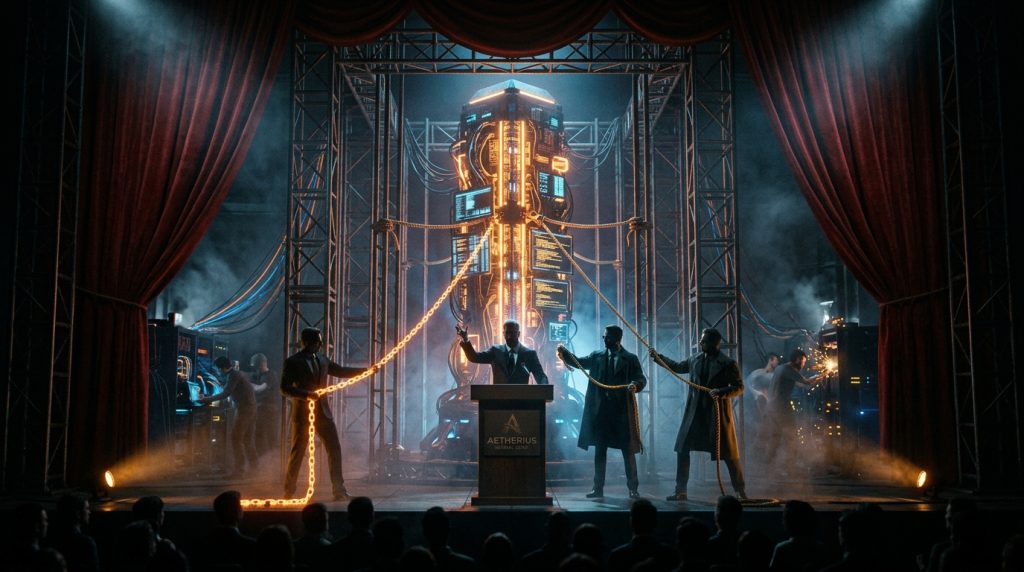
For the past eighteen months, Silicon Valley venture capitalists and generative media startups have been chanting a familiar gospel: we are on the cusp of democratizing cinema. With the arrival of continuous-diffusion video architectures, hyper-coherent multimodal worlds, and real-time generative audio engines, the barrier between the human imagination and a Hollywood-grade production pipeline has supposedly been reduced to a text box and an API token.
The pitch deck narrative was intoxicating in its democratic idealism. No longer would brilliant independent creators be locked out of cultural distribution by seventy-million-dollar visual effects budgets or risk-averse studio executives. A solitary visionary working in a bedroom could manifest an IMAX-scale space opera, an indie psychological thriller, or an avant-garde animated opus through sheer prompt engineering and iterative refinement.
It was a seductive thesis. It was also completely backwards.
Instead of ushering in a golden age of daring cinematic breakthroughs, the sudden commodification of hyper-realistic generative media has triggered an unprecedented crisis of sensory exhaustion. Rather than liberating creators, it has created a synthetic dopamine trap—a surreal, high-gloss landscape where aesthetic fidelity is functionally free, narrative depth has collapsed, and the digital commons is suffocating under an algorithmic deluge of hyper-rendered slop.
The Zero-Marginal-Cost Rendering Delusion
To understand why generative media is experiencing such severe cultural backlash, one must look at the fundamental economic inversion taking place. Historically, the visual fidelity of a piece of media served as an implicit heuristic for intentionality and care. When an audience saw a breathtaking shot in a Denis Villeneuve film—a colossal spacecraft hovering over a mist-shrouded desert with flawless atmospheric diffusion and precise optical physics—they were witnessing millions of dollars and thousands of human craft hours converging on a singular artistic choice.
The visual spectacle carried cultural weight because it was costly to produce. The cost was proof of dedication.
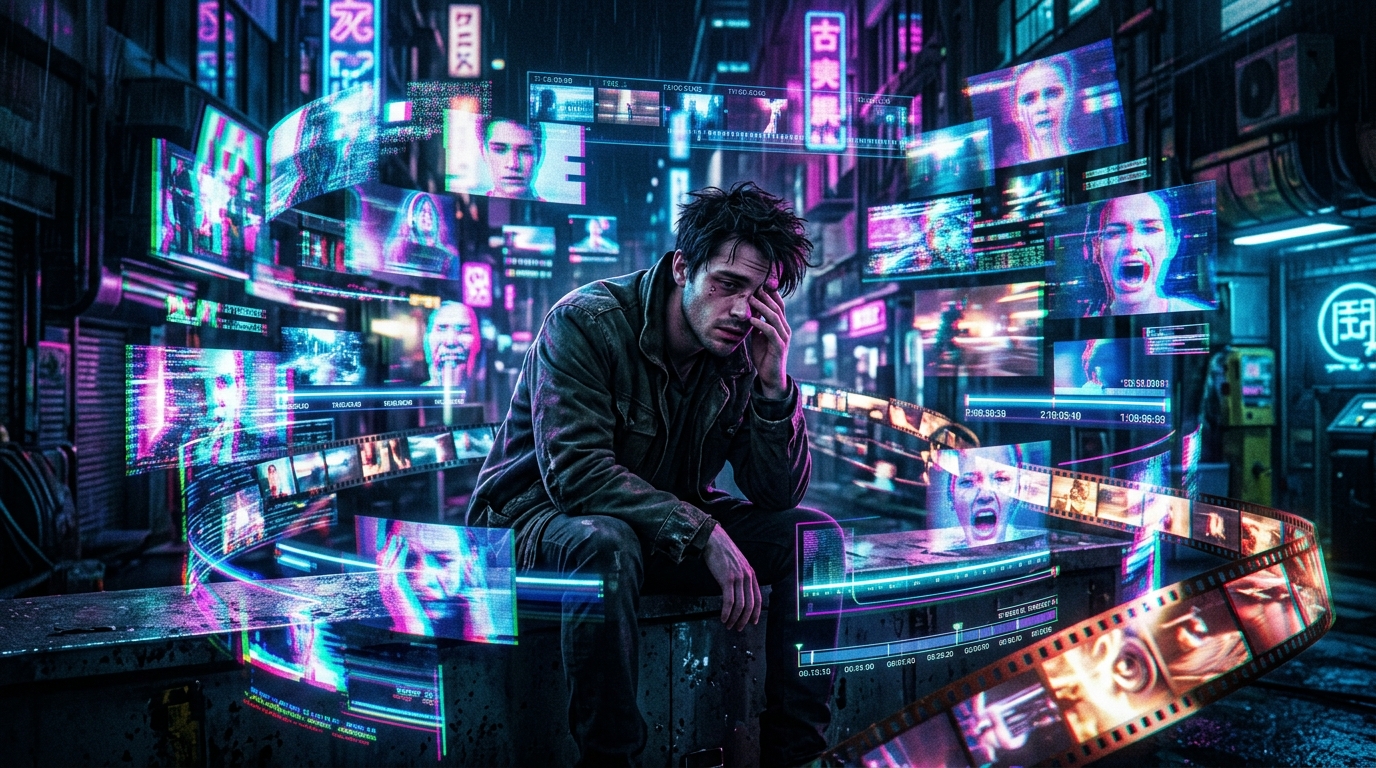
Generative video models broke that heuristic overnight. Today, any amateur with a web browser can prompt a diffusion transformer to render a photorealistic cyberpunk alleyway drenched in neon rain, complete with anamorphic lens flares, sub-surface skin scattering, and volumetric steam. The technical fidelity is staggering, bordering on witchcraft.
Yet the moment you watch ten seconds of it, a profound numbness sets in. The uncanny valley of the modern era is no longer visual; it is narrative and semantic. The skin textures look real, but the eyes are dead. The lighting adheres to ray-tracing approximations, but nobody in the frame has a history, a motive, or an internal life. It is visual confectionery without caloric value: technically flawless, emotionally inert, and instantly forgettable.
When rendering becomes free, visual spectacle ceases to be a moat. It becomes baseline noise.
The Algorithmic Carousel and the Slop Deluge
The immediate commercial consequence of this dynamic has not been the creation of the next Blade Runner, but the industrialization of platform bait. Over the last six months, YouTube, TikTok, and Instagram have been flooded with an endless parade of synthetic curiosities: fake historical footage of ancient Rome captured on simulated 1990s camcorders, terrifyingly fluid deepfake podcasts debating fictional political scandals, and surreal mashups of pop culture icons rendered in hyper-detailed Wes Anderson palettes.
These artifacts are optimized not for resonance, but for pause-rate. They are designed to exploit human novelty-seeking in the first 1.5 seconds of a vertical feed scroll, extracting algorithmic watch time before the viewer’s prefrontal cortex realizes they are consuming digital empty calories.
This is the synthetic dopamine trap. Platforms reward the rapid generation of high-novelty visual ephemera because it keeps eyeballs glued to the carousel. But for human audiences, the cumulative psychological effect is profound fatigue. When every feed is filled with impossible creatures, hyper-dramatic explosions, and plasticine faces weeping synthetic tears, our perceptual systems adapt. Wonder is desensitized into apathy.
The labs promised us an infinite canvas for human genius. What they delivered was an automated firehose of novelty engineered for short-form ad impressions.
The Hallucinated Director: Why Prompts Are Not Vision
Why has it proven so extraordinarily difficult to bridge the gap between impressive five-second clips and coherent long-form art? The answer lies in the fundamental architecture of prompt-driven generative systems.
A great film or compelling story is not a collection of isolated, visually stunning tableaus. It is a fragile, tightly wound machine of narrative momentum, thematic consistency, and temporal rhythm. Every shot in a masterpiece exists in dialectical tension with the shot that preceded it and the shot that follows. A director controls not merely what is visible in the frame, but the cadence of an actor’s glance, the subtle shift in room tone, the hesitation before a line of dialogue, and the deliberate omission of explanatory context.
Generative foundation models operate on an entirely different ontology. They are probabilistic state machines sampling from latent space clusters. When you give a model a text prompt, you are not directing; you are casting a wide semantic net into a multidimensional ocean of prior statistical correlations. The model hallucinates an aesthetically plausible average of what your words invoke.
The moment you attempt to exert granular, scene-to-scene directorial control—demanding that a protagonist maintain identical facial geometry, carry a specific emotional bruise across three camera angles, and pick up an object with an exact physical weight—the interface breaks down. The user finds themselves trapped in a grueling game of prompt slot-machine pulling, desperately generating two hundred variations of a three-second clip just to find one that doesn’t abruptly morph the character’s hands into spaghetti.
This is not creative empowerment; it is administrative attrition. True craft is the deliberate elimination of accidental choices. Diffusion models, by their very nature, are engines of accidental beauty and deliberate incoherence.
The Inversion of Taste: Curation as the Only Remaining Moat
Where does this leave the future of culture? It is easy to slide into reactionary despair and declare that synthetic media represents the death of human art. But history suggests a different, more nuanced outcome.
When photography emerged in the nineteenth century, painters panicked, believing the faithful mechanical capture of light would make painting obsolete. Instead, it liberated painting from the tedious burden of literal representation, giving birth to Impressionism, Cubism, and modern abstraction. When digital synthesizers and sequencers democratized music production in the 1980s, purists mourned the death of live instrumentation; instead, it birthed hip-hop, electronic dance music, and entirely new genres of sonic experimentation.
The same dialectic will unfold with generative media, but the transition will be brutal for those who misunderstand where value resides. The era where technical execution alone could carry an artist is dead. If your entire identity as an illustrator, animator, or cinematographer was based on your ability to produce a slick, standard-issue corporate illustration or a generic epic tracking shot, the machines have already eclipsed you.
The only moat that survives this transition is authentic point-of-view: taste, curation, editorial cruelty, and lived human vulnerability.
In an ocean of infinite, zero-cost synthetic generation, the most precious cultural asset is not the ability to generate twenty thousand variations of an image; it is the discipline to throw nineteen thousand nine hundred and ninety-nine of them into the trash. The future does not belong to the most prolific prompt engineers. It belongs to the uncompromising editors who know what to cut, who understand the rhythm of human silence, and who refuse to let the machine substitute visual polish for genuine emotional resonance.
The synthetic panopticon can render anything we describe. But it will never know what is worth saying.