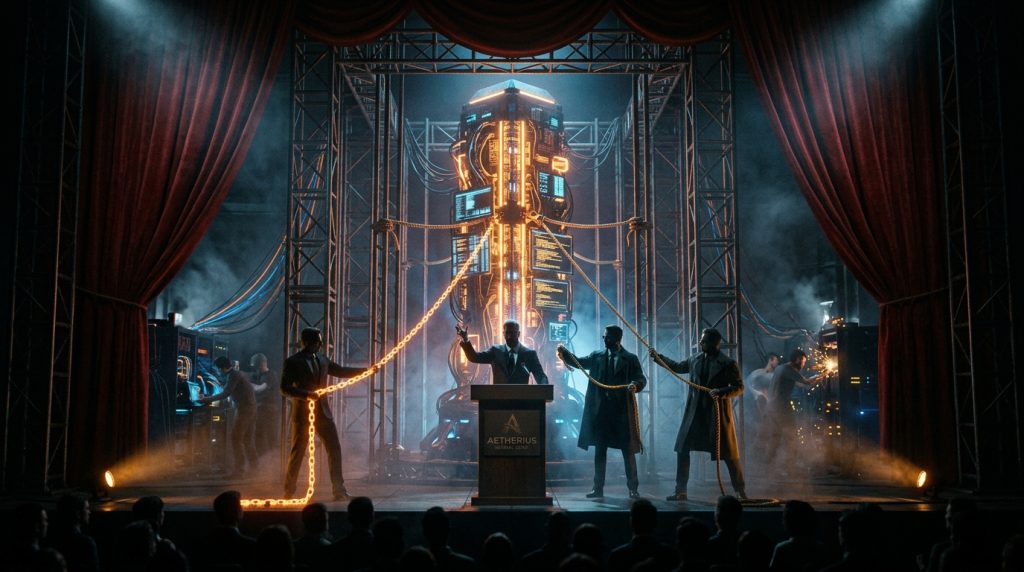
For the past eighteen months, the cathedral of frontier artificial intelligence has been sustained by a singular, seductive catechism: pre-training scaling laws might be flattening against the jagged limits of human-authored text and nuclear power interconnection queues, but salvation has arrived in the form of inference-time compute.
The narrative is practically irresistible to venture capital and benchmark maximalists alike. If a model cannot solve a problem with twenty tokens of next-token prediction, we simply let it “think.” We grant it a private scratchpad, an unconstrained hidden reasoning budget, a Monte Carlo tree search over latent token trajectories, and thousands of test-time floating-point operations. We are assured that reasoning models do not merely guess—they self-correct, backtrack, simulate hypothetical states, and arrive at truth through sheer compute-dense contemplation.
The YouTube tech circuit and Silicon Valley keynote stages have predictably lost their collective minds. We are told that autonomous coding agents, legal synthesis engines, and robotic controllers are on the verge of synthetic transcendence. Just turn the reasoning knob to maximum, burn forty watts of datacenter power per prompt, and watch the model navigate reality.
There is only one slight hitch: in the real world of distributed systems, messy toolchains, and adversarial entropy, thinking longer is not the same thing as understanding what you are looking at.
The Epistemic Illusion of Latent Chain-of-Thought
To understand why the current discourse around reasoning models is fundamentally deranged, one must dissect what actually happens during test-time compute. A reasoning model does not retreat to a quiet study with an espresso to ponder the ontological essence of your bug. It does not possess a grounded causal model of reality.
What it possesses is an extended autoregressive rollout mechanism guided by process reward models (PRMs) or reinforcement learning from verifiable rewards (RLVR). When faced with a complex prompt, the system generates dozens—sometimes hundreds—of intermediate reasoning tokens. It generates candidate paths, scores them against statistical heuristics of “good reasoning steps,” and prunes branches that appear unpromising.
In closed, deterministic toy domains with clean verifiers—competitive programming contests, formal mathematical proofs, synthetic chess puzzles—this works like black magic. The rules are invariant, the compiler provides immediate binary truth, and the problem space is topologically closed. If branch $A$ produces an unhandled exception or a broken proof step, the search algorithm penalizes the path and backtracks to branch $B$.
Vendor hype takes this narrow triumph and extrapolates it across the entirety of human enterprise. The sales pitch assumes that if an extended reasoning loop can solve an Olympiad geometry puzzle, it can naturally untangle a legacy Kubernetes control plane, orchestrate multi-agent microservices, or refactor a fifty-thousand-line distributed database client.
This is where the epistemic illusion collapses.
When Search Collides with Unbounded State Space
In open-world computing environments, problems do not fail because an agent lacked the arithmetic capability to solve them. They fail because the external environment violates the foundational assumptions baked into the model’s training distribution.
Consider what happens when you turn an extended reasoning agent loose on an ambiguous production issue:
- The Hallucination Cascade of Search: In formal math, invalid logical steps lead to demonstrable contradictions. In software architecture and cloud infrastructure, invalid premises often sound brilliantly plausible. When a reasoning model hallucinates a non-existent API flag or misunderstands an eventual-consistency edge case at token step 15, it does not discard that premise. Instead, it spends the next 800 tokens of test-time compute constructing an intricate, mathematically elegant cathedral of rationalizations on top of a rotten foundation. It literally rationalizes its own hallucination into dogma.
- The Verification Deficit: Test-time compute relies entirely on the quality of its verifier. Who is verifying the intermediate thoughts of an autonomous agent operating across external APIs? In most commercial agentic harnesses, there is no formal verifier. There is only an auxiliary LLM acting as a judge—which shares the exact same systemic blind spots, training biases, and contextual vulnerabilities as the generator. You are having one delusional model audit the stream-of-consciousness diary of another delusional model.
- Cost and Latency Asymmetry: A traditional API call to an optimized service takes 15 milliseconds and costs $0.00001. A frontier reasoning model spending forty seconds simulating sixteen possible tool invocations to parse an ambiguous schema consumes immense GPU memory and dollars—only to conclude with high confidence that you should restart a container that was already running fine.
We are watching the industry burn hundreds of millions of dollars replacing elegant, deterministic control loops with sprawling, probabilistic monologues.
The Cult of the “Autonomous Coding Agent”
Nowhere is this test-time delusion more breathlessly worshipped than in the current frenzy around autonomous coding tools. Every week brings a fresh demo video of an agent creating an entire full-stack clone of Slack or Figma in three minutes while the creator gushes over the death of human engineering.
Look beneath the hood of those demos, however, and the reality is far more sobering. These models excel at greenfield boilerplate generation precisely because GitHub is saturated with thousands of identical Next.js templates, Tailwind configurations, and CRUD endpoints. The model isn’t “engineering”; it is replaying high-dimensional patterns from its training corpus.
Real engineering begins when the greenfield ends. It begins when you have to maintain backward compatibility across seven schema migrations, navigate undocumented legacy behaviors in a third-party payment gateway, and diagnose why a background thread locks up only when the network latency between two regions exceeds 45 milliseconds.
When you feed that kind of problem to an autonomous agent backed by test-time compute, you don’t get elegant systems design. You get what I call Syntactic Sprawl: the agent will happily refactor three hundred files, invent sixty helper abstractions, introduce twenty unnecessary npm packages, and wrap the underlying failure in five nested try-catch blocks that swallow the actual exception.
The agent “worked hard.” The reasoning trace looks breathtakingly sophisticated. The git diff is four thousand lines long. And the system is ten times more fragile than when it started.
Architectural Invariants Over Compute Maximalism
The dirty secret of modern AI engineering is that no amount of inference compute can compensate for an architectural boundary violation.
If your system lacks deterministic state boundaries, if your interfaces are loosely typed and poorly specified, if your data contracts leak implementation details across trust boundaries, throwing an extended-thinking model at the problem is simply pouring high-octane gasoline onto a tire fire. It accelerates the chaos while providing a false sense of cognitive security.
The antidote to the test-time delusion is not cynicism toward AI capabilities—these models are formidable statistical instruments when harnessed properly. The antidote is ruthless engineering discipline:
- Hard Verifiers Over Soft Reasoning: Stop asking LLMs to evaluate whether code or configuration is valid. Use strict static analyzers, formal schemas, deterministic fuzzers, and compiler invariants. If a step cannot be verified by a deterministic runtime check, assume the agent’s reasoning is speculative at best.
- Constrained Action Radii: Never give an agent unconstrained tool freedom under the belief that its internal reasoning will keep it safe. Bound its blast radius. Limit its write permissions to tightly scoped, reversible state changes.
- Shorter Horizons, Tighter Loops: The longer an agent spends “thinking” in a closed loop without grounding itself against real system responses, the higher the probability of epistemic drift. Replace deep, unmonitored test-time rollouts with shallow, rapid cycles of hypothesize-test-verify.
The Inevitable Hangover
The tech industry loves nothing more than a silver bullet that promises to turn difficult, messy engineering into an undifferentiated compute commodity. For the last two years, that commodity was pre-training scale. Today, it is test-time compute.
Eventually, the enterprise bills will come due, the latency numbers will prove unbearable for interactive user experiences, and the brittle wreckage of agent-generated codebases will demand human triage. When that hangover arrives, the teams that thrive won’t be the ones that burned the most gigawatt-hours watching models talk to themselves in the dark.
They will be the ones who remembered that engineering has always been about constraints, interfaces, and invariants—and that clarity of thought will always triumph over volume of compute.