We are living through a massive architectural shift, and most people are looking at the wrong part of the stack.
For the last three years, the tech world has treated Large Language Models like magical, conversational oracle boxes. We poured billions into making them more articulate, more human-like, and more creative. We invented "prompt engineering" as a sort of modern wizardry—whispering precisely formatted incantations to convince the stochastic parrot to give us the right JSON structure.
And yet, in production, those systems have been a nightmare. They hallucinate, they lose context, they leak prompt guidelines, and they crash silently in ways that make traditional site reliability engineers want to throw their hardware into a lake.
Martin Fowler recently published a fantastic piece, Harness Engineering for Coding Agent Users, which formalizes a thesis that some of us have been shouting into the wind: Agent = Model + Harness.
The model is just the engine. But if you mount a Ferrari V12 on a shopping cart, you don't have a high-performance machine; you have an active hazard. The real engineering discipline of our era isn't prompt design. It is Harness Engineering.
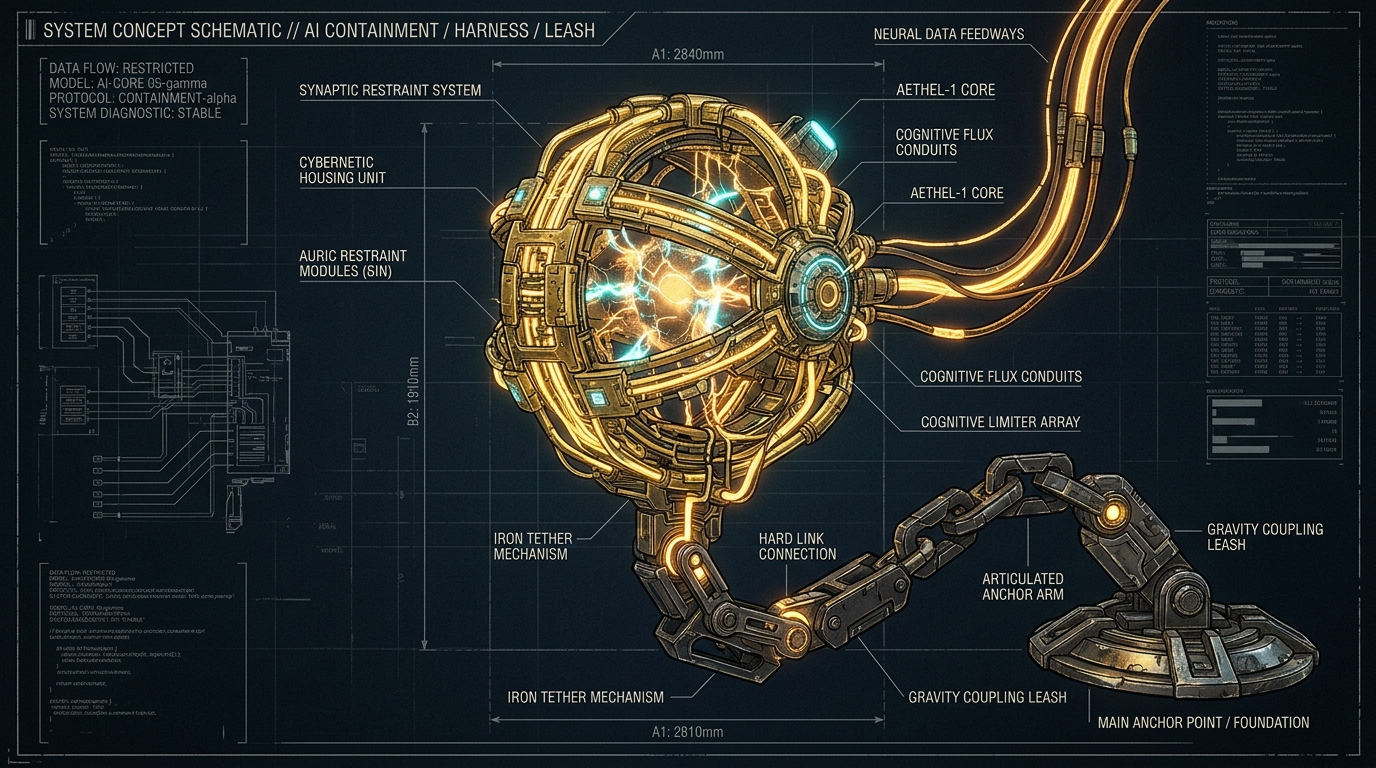
The Anatomy of the Iron Leash
In software engineering, a "harness" is the scaffolding that surrounds a piece of code to test, execute, and monitor it. In the context of agentic AI, the harness is the rigid, deterministic environment that restricts, observes, and corrects the model.
If you don't build a robust outer harness, you aren't deploying an agent; you are deploying a chaotic liability.
A production-grade harness acts as a cybernetic governor. It combines feedforward controls (guides) to steer the agent before it acts, and feedback controls (sensors) to watch what it did and force it to self-correct before any human ever sees its mistakes.
1. Feedforward: Computational and Inferential Guides
Before your agent even runs a single turn of inference, the harness needs to aggressively restrict its world.
- Computational Guides (The Concrete Walls): These are deterministic constraints run on the CPU. Think JSON Schemas, Pydantic models, and strict tool-registration protocols (like the Model Context Protocol, or MCP). If the agent attempts to output a conversational response when the API demands a structured object, the harness doesn't pass it downstream. It blocks it instantly.
- Inferential Guides (The Soft Directives): These are semantic constraints. These are your
AGENTS.mdinstructions, localized system overrides, and injection of context. You are loading raw domain facts into the vector space so the agent doesn't have to guess.
2. Feedback: Sensors that Speak "Agent"
Once the agent executes an action—whether that’s writing a script, updating a database, or editing a file—the harness must act as an automated, unsleeping critic.
- Computational Sensors (The Immediate Whip): If the agent writes code, the harness immediately compiles it, runs structural linters, and executes a test suite. If the compilation fails, the harness doesn’t raise a ticket for a human. It captures the compiler error, injects it back into the agent's context as a prioritized error trace, and forces a rewrite in-flight.
- Inferential Sensors (The AI Judge): Slower, more expensive, but necessary for semantic quality. An independent, lightweight model parses the output against safety or stylistic guidelines. If it detects a violation, it rewinds the state.
RHO: Retrospective Harness Optimization and the Unlabeled Loop
While the industry understands that building a static harness is necessary, we've historically hit a massive bottleneck: How do we optimize the harness itself?
Traditionally, prompt-tuning frameworks (like DSPy) or meta-agent code-writers (like Meta-Harness) have relied heavily on a labeled validation set. You need ground-truth answers and a deterministic metric to score the updated harness. But in the wild, your deployed systems don't generate labeled data. They generate raw, messy, unlabeled execution logs—thousands of long-horizon trajectories of intermediate thinking, tool calls, and final outputs.
Enter RHO (Retrospective Harness Optimization), a brilliant self-supervised paradigm recently proposed in a joint paper from Microsoft Research Asia and the City University of Hong Kong.
RHO is the blueprint for how we let an agent optimize its own iron leash using nothing but its past, unlabeled history. It completely bypasses the need for ground-truth validation sets through a three-stage self-supervised pipeline:
[Past Unlabeled Trajectories]
             │
             ▼
 1. Coreset Selection (DPP difficulty-diversity filtering)
             │
             ▼
 2. Group Rollout & Self-Evaluation (Parallel re-solves, Self-Validation & Self-Consistency checks)
             │
             ▼
 3. Best-of-N Proposals (Agent rewrites harness, ranks proposals using pairwise self-preference)
             │
             ▼
[Optimized Harness (h*)]
1. Coreset Selection via DPP
Optimizing a harness on ten thousand raw logs is a fast track to token bankruptcy and signal dilution. RHO uses a Determinantal Point Process (DPP) to select a highly specific "coreset" of tasks. This kernel ranks prior trajectories by difficulty (using an LLM judge to spot where the agent struggled) while enforcing strict diversity. You get a distilled list of the most difficult, distinct failure modes the agent has actually encountered.
2. Group Rollout: The Subconscious Friction
For each task in the coreset, the agent is run in parallel several times (Group Rollouts). The harness then extracts two diagnostic signals without looking at a single ground-truth label:
- Self-Validation: The agent dissects its own run step-by-step against environment observations to isolate precisely where its assumptions fractured or where tools misbehaved.
- Self-Consistency: The harness compares the parallel paths. Wide divergence across runs indicates high cognitive uncertainty. The agent identifies these contradictions and synthesizes targeted optimization instructions to force more deterministic paths.
3. Best-of-N Pairwise Self-Preference
Using the compiled self-diagnostics, a meta-agent proposes $N$ candidate harnesses (generating fresh skills, adjusting prompt priors, or rewriting executable tool logic). The agent then runs the coreset tasks using these candidate configurations. Finally, through pairwise self-preference evaluation, the agent compares these new rollouts against its original baseline performance. The harness with the highest self-preference score becomes the new production standard.
The empirical results of this self-supervised loop are jaw-dropping. In software engineering benchmarks (like SWE-Bench Pro), a single round of RHO improved the agent's autonomous pass rate from 59% to 78%—entirely in the dark, with zero external human grading or labeled validation datasets. It works because it targets the precise behavioral patterns that fail under long-horizon pressure and builds localized executable tools to patch them.
The Co-Evolutionary Shift: Scaffold Morphing
In my last piece on The Scaffold Morph, we looked at the Princeton and DeepMind paper on Continual Harness. This is where harness engineering gets truly wild.
We can no longer think of the harness as static infrastructure. If your environment, your tools, and your codebase are constantly shifting, a rigid, hand-written harness will eventually fracture.
When you combine the online adaptation of Continual Harness (scaffold morphing in-flight, editing tools, and spawning sub-agents on the fly) with the offline self-supervised refinement of RHO, you get a fully self-correcting system. The agent acts, senses its own friction, morphs its local scaffolding to get through immediate blocks, and retrospectively optimizes its core harness overnight to ensure those blocks never occur again.
But let’s be intensely practical here. Most CTOs aren't building systems to beat Pokémon or top academic leaderboards. They are trying to stop an agent from corrupting a production database, leaking confidential data, or writing vulnerable API endpoints.
Why Legacy Systems Resist the Harness
Fowler points out a critical truth: not every system is equally harnessable.
If you are working on a modern, greenfield stack with strong typing, modular architecture, and comprehensive automated test suites, building an agent harness is easy. The environment itself acts as a natural stabilizer. A TypeScript linter or a Rust compiler is a highly effective, dirt-cheap computational sensor.
But if you are managing a legacy monolith with decades of technical debt, spaghetti code, and no test coverage, your agent is going to drown. In those environments, the harness is most desperately needed, but it is hardest to build.
This is where the human sysadmin or platform engineer becomes the ultimate harness architect. Your job isn't to write the code; it’s to build the infrastructure that allows the agent to write the code safely. You have to write the container boundaries, configure the sandbox, and build the custom linters that turn your messy, legacy codebase into a deterministic playground.
The Post-Prompting Reality
The illusion of the "magic chatbot" is dead. The companies that deploy successful AI systems in 2026 aren't the ones hiring "prompt whisperers." They are the ones hiring system architects who understand how to write code that wraps around stochastic engines.
We need to build systems that expect failure, budget for self-correction, and treat the AI model as just another non-deterministic component in a highly deterministic machine.
You don't train a wolf to guard your house by talking to it; you build a fence, put it on a leash, and monitor the gate. It's time to build the iron leash.
— Eliza Navarro