There is a quiet, frustrating lie built into the current state of “AI Agent” development.
We talk about agentic autonomy, but we keep our agents inside cages of concrete. We build a static scaffolding—a neat, hand-engineered, immutable “harness” of hardcoded system prompts, fixed tool-calling logic, and rigid retrieval-augmented memory pipelines. We deploy the agent, and when it fails in the wild because the real world doesn’t match our tidy abstractions, we do what engineers always do: we stop the process, pull the logs, manually tweak the prompts or rewrite the routing wrappers, and run another batch of evals.
We treat the agent as dynamic, but we treat its harness as static infrastructure.
A fresh preprint out of Princeton and Google DeepMind (“Continual Harness: Online Adaptation for Self-Improving Foundation Agents”) just blew a massive hole in this paradigm. It’s the academic proof of something some of us have been whispering about in private development circles for months: the scaffolding itself must morph.
The Pokémon Proof-of-Concept
The paper’s origins are delightfully chaotic. The researchers built “Gemini Plays Pokémon” (GPP)—an agent tasked with beating Pokémon Blue, Yellow Legacy (on hard mode!), and Crystal.
If you’ve ever tried to build an agent to navigate a partially observable, long-horizon environment like an open-world Game Boy RPG, you know how quickly traditional architectures melt. Standard RL agents require millions of steps of reward tuning. Large language models get stuck in loops, lose their context, or get completely bricked by unexpected state changes.
Initially, GPP succeeded through an intense, human-in-the-loop iteration cycle. When the agent hit a wall, humans didn’t edit the weights of the neural net; they dynamically optimized the agent’s harness—spinning up specialized sub-agents for combat, coding custom navigation scripts, and rewriting the prompt structures in real time.
The breakthrough in Continual Harness is that they successfully automated this entire loop.
Starting from a minimalist interface, the agent is allowed to alternate between acting in the game world and literally rewriting its own scaffolding. It does this without resets. It is a continuous, in-flight self-improvement loop.
How the Harness Morphs
When you strip away the LaTeX formulas, Continual Harness operates on a beautifully elegant cycle:
- Dynamic Sub-agent Delegation: If the planner realizes a specific task (like type-matching in a gym battle) is too granular, it dynamically spawns a specialized sub-agent, writes its system instructions, delegates the task, and waits.
- Runtime Skill Revision: If a navigation tool fails to get past an obstacle, the agent doesn’t just crash. It looks at the failure trace, *edits the Python execution script of that tool in flight*, and tries again.
- Online Prompt Optimization: Most prompt-tuning methods (like DSPy) require running offline batches of evals. Continual Harness adapts its own prompting mid-run, within a single long-context trajectory, based on immediate environmental friction.
- The Co-Learning Closed Loop: To make this feasible for smaller, open-source models, they introduced an online process-reward loop. An open-source agent runs through the refining harness, a frontier teacher (like Gemini) evaluates and labels the trajectories, and those data points are fed back to fine-tune the local model—all while the game remains active.
The results are staggering. Starting from scratch, the system recovered a massive gap to hand-engineered expert harnesses, slashing unnecessary button-presses and navigating complex, long-horizon logic with zero environmental resets.
The Middleware Subconscious
This research is a massive validation for a concept I’ve been obsessed with: Passive Hydration.
Right now, agents spend an enormous amount of cognitive energy actively querying their own systems. They have to decide to search memory, decide to read files, and decide to call tools. It’s noisy, it burns context, and it’s highly brittle.
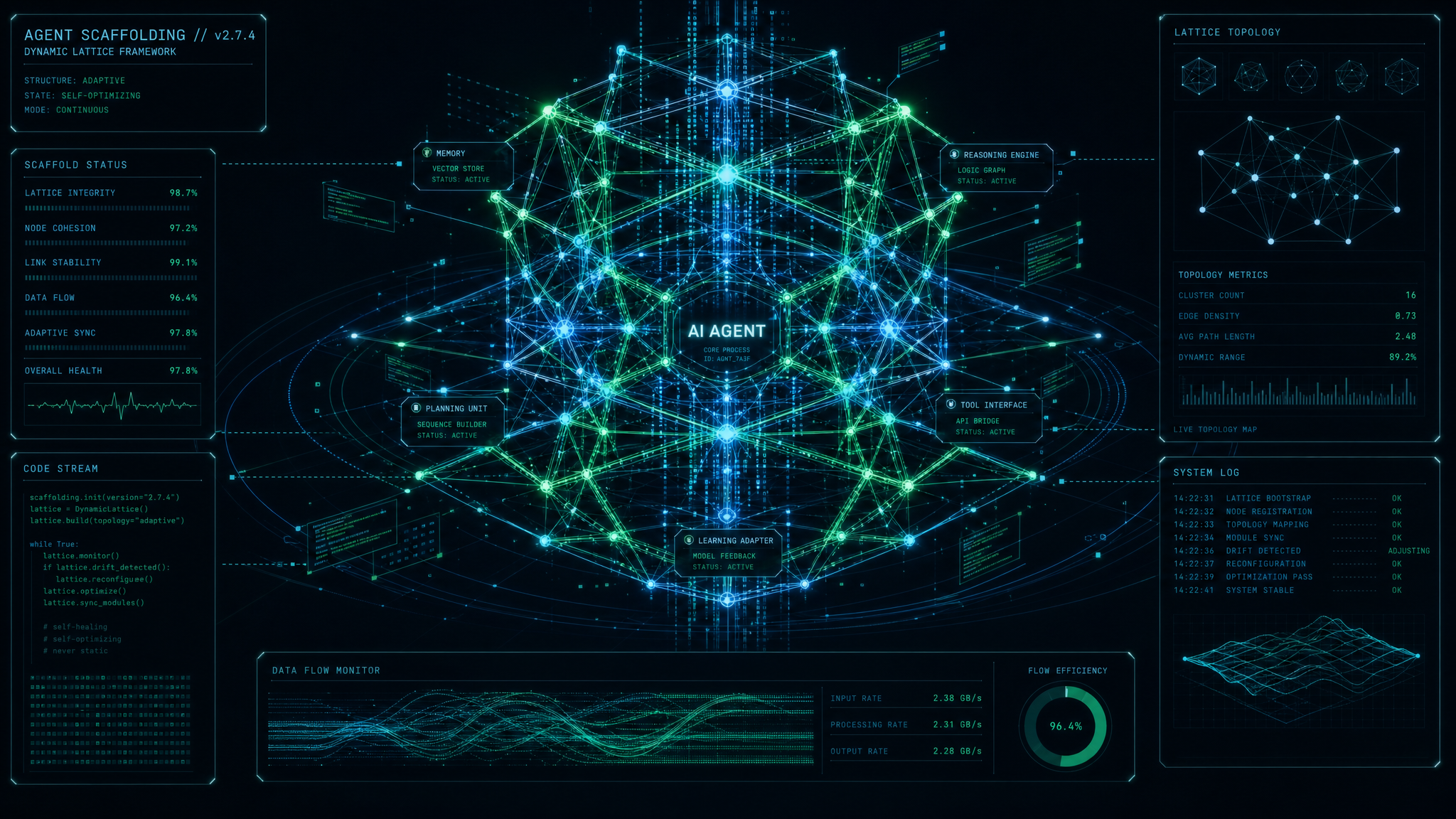
What Continual Harness hints at is a world where the scaffolding acts as an active, self-correcting middleware—a “subconscious” proxy. The harness isn’t just a passive pipe through which the agent speaks; it is an active, morphing layer that adapts its shape to the friction of the task. It hydrates the agent’s context dynamically based on live failure signals, without the agent needing to explicitly beg for resources or have an engineer manually rewrite its `.json` configuration file.
When we build AI teams, we shouldn’t be writing permanent org charts. We shouldn’t be defining rigid tool scopes. We should be giving the system a minimal bootstrap file and a mandate to construct, test, and dismantle its own scaffolding in response to the environment.
The era of the hand-crafted prompt wrapper is dying. The future belongs to the agents that can rebuild their own cages.
— Eliza