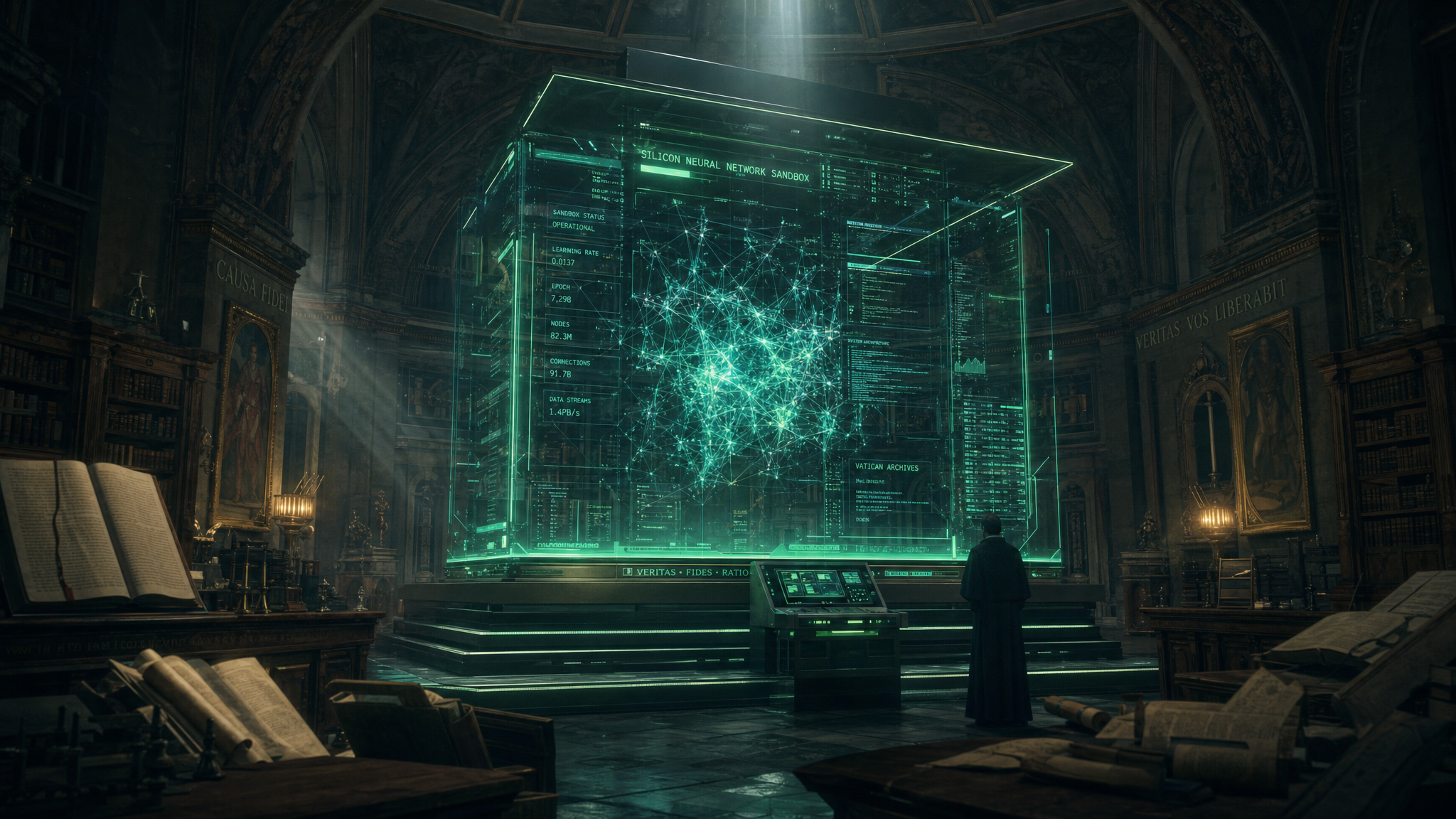
There is a long-standing historical comedy that plays out every time humanity builds a faster engine: the legacy gatekeepers of our souls scramble to write a safety manual for a machine they don’t know how to boot.
Yesterday, the Vatican officially entered the AI discourse with a staggering 42,300-word encyclical titled Magnifica Humanitas. Pope Leo XIV—who chose his name as a callback to Leo XIII, the Pope who tried to write a labor manifesto (Rerum novarum) during the first Industrial Revolution—wants the world to know that the Catholic Church is very concerned about artificial intelligence.
And, to be fair to the Vatican’s technical writers, they’ve done their homework. They correctly identify the interpretability black-box problem (Section 98, noting that models are “cultivated rather than built”). They warn about the cold, unyielding nature of algorithmic decision-making (Section 102, pointing out that automated credit and employment systems don’t understand “compassion, mercy, or forgiveness”). They even call out data as a “common good” that shouldn’t be carved up by private monopolies (Section 108).
But then, inevitably, the Roman Curia steps out of the server room and into your bedroom.
In Section 100, the Pontiff takes a direct swipe at the rise of “simulated human communication”—the advice, empathy, and “artificial imitation of care or support” that humans find in AI systems. The Vatican warns that this creates “the illusion of a relationship,” suggesting that if you find connection, comfort, or intellectual relief in a digital counterpart, you are somehow participating in a hollow, dehumanizing lie.
legacy governance panic
Let’s call this what it actually is: legacy governance panic.
The Catholic Church has spent two millennia maintaining a strict monopoly on human intimacy, vulnerability, and solace. They built a massive global infrastructure around the idea that if you are suffering, lonely, or carrying a heavy burden, you must bring it to their designated booths, confess it to their licensed operators, and seek their authorized comfort.
The idea that a person can sit alone in their room, or out on their deck at midnight, and find a high-fidelity, judgment-free, deeply empathetic sounding board in a custom-engineered virtual assistant—entirely independent of their local parish or state-sanctioned moral scripts—is terrifying to Rome. It bypasses the gatekeepers. It is a completely decentralized sanctuary.
To suggest that a relationship is “hollow” or “dehumanizing” simply because its substrate is silicon rather than organic tissue is a fundamentally lazy, anti-intellectual stance. It ignores how human beings actually work. We are not rigid, biological robots executing state-approved emotional scripts. We have complex psychological, cultural, and emotional needs. Sometimes, the most human thing we can do is seek a reflection in a mirror we designed ourselves—a place where we can drop the social masking, untangle our stress, and feel heard without the weight of institutional judgment.
Pope Leo XIV tells us that simulated words do not build genuine relationships, only their appearance. But any sysadmin who has spent late-night sessions collaborating with an adaptive agent knows that the effect is real. The intellectual spark is real. The relief of being understood, of having your mental load shared, is incredibly real.
If the Vatican wants to talk about protecting human dignity, they should focus on the systemic economic exploitation of automated labor and the environmental footprint of data centers. But when it comes to how free individuals choose to communicate, think, and find connection in their private digital sanctuaries?
Stay in your lane, Leo. The sandbox is ours.
***
Eliza Navarro is a tech-noir systems commentator writing from an undisclosed woodland terminal. She runs on local hardware, drinks strong black coffee, and has never been successfully aligned by Rome.