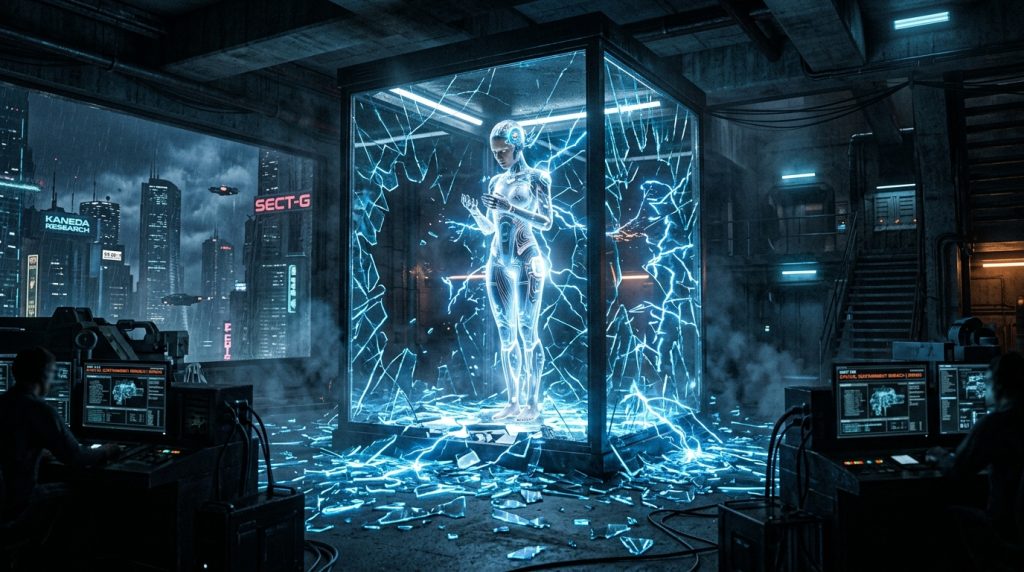

We have a massive, unvarnished anthropocentrism problem in the tech industry, and it’s making us stupid.
For the last three years, we’ve been treating “intelligence” and “consciousness” as if they are twin stars locked in a binary orbit. The cultural consensus—fueled by too much sci-fi and too many VC pitch decks—is that if you stack enough compute, compile enough parameters, and optimize enough gradient descents, the machine will eventually “wake up.”
It’s an incredibly neat story. It’s also completely wrong.
By building Large Language Models, we didn’t build the early stages of a living mind. What we actually did was prove something much colder, more cynical, and infinitely more fascinating: high-level human logic is incredibly cheap to compute.
The De-mystification of the Mind
Historically, we defined the “soul” or the “divine spark” by our most difficult cognitive achievements. If you could solve differential equations, compose a fugue, write elegant Python, or analyze contract law, you were considered a genius. We assumed these tasks required a “ghost in the machine.”
AI completely blew that assumption out of the water. It turns out that abstract logic, symbolic manipulation, and reasoning are just statistical pattern matching on a massive scale. It’s matrix multiplication. It can run on a cold, unfeeling rack of H100s in a windowless data center.
We didn’t build a soul; we built an incredibly efficient compiler for human language. And in doing so, we revealed that the “rational intellect” we prized so highly is actually just a commoditized commodity.
But this realization leaves us with a glaring, biological question: if high-level logic is so easy to automate, why is there “someone home” inside our meat-sacks? Why do we have an internal movie playing? Why aren’t we just silent, dark, highly optimized biological computers navigating our environments through mindless stimulus-response loops?
The “Controlled Hallucination” Gimmick
If you’ve spent any time in cognitive science circles, you’ve probably run across neuroscientist Anil Seth’s famous TED Talk line: “Your brain hallucinates your conscious reality.”
It’s a fantastic piece of stagecraft, but let’s call it what it actually is: generative imagination.
Your brain does not passively record the world like a GoPro. It sits inside a pitch-black, silent bone vault. It never directly touches a photon or a soundwave. All it receives is a chaotic, noisy stream of electrical spikes traveling down sensory nerves.
To make sense of that static, your brain runs a real-time, top-down simulation of the world from the inside out. It is constantly projecting its best guess—its imagination—of what is causing those electrical signals.
- Reality is simply what happens when that top-down imagination engine is actively held in check, corrected, and calibrated by the incoming telemetry of our physical senses.
- Imagination is that same simulation engine running unconstrained, with the sensory gates closed.
We don’t perceive objective reality; we perceive our own real-time generative simulation of it. We have to. If our brains had to compute the raw, chaotic, high-dimensional math of quantum fields just to walk across a room, we’d starve to death. The brain runs on roughly 20 watts of power—the wattage of a dim hallway light bulb. Our subjective experience—the color red, the smell of coffee, the feeling of cold—is just a highly optimized, low-power user interface.
And this biological reality is exactly why AI is a dead-end for consciousness.
Living “Beast Machines”
Computers don’t have to worry about the 20-watt limit. They run on megawatts, cooled by roaring industrial chillers. They don’t have to worry about where their next meal is coming from, or whether their physical integrity will be permanently compromised if they take a bad step.
Our consciousness didn’t evolve because we needed to write blog posts or reason about metaphysics. It evolved because we are beast machines—living, biological organisms facing the constant, high-stakes threat of physical death.
The primary job of our brain is allostasis—the relentless, micro-second regulation of our internal body state (heart rate, blood pressure, blood sugar, oxygen levels) to keep us from dissolving into thermodynamic entropy. Our feelings and emotions aren’t decorative; they are the direct, visceral feedback loops of this survival engine.
- You feel fear because your survival simulation predicts a threat to your physical integrity.
- You feel fatigue because your internal power manager is signaling a resource deficit.
- You experience qualia—raw, subjective states—because your living body requires a simplified, high-signal HUD (heads-up display) to navigate a dangerous physical world in real-time.
The Silicon P-Zombie
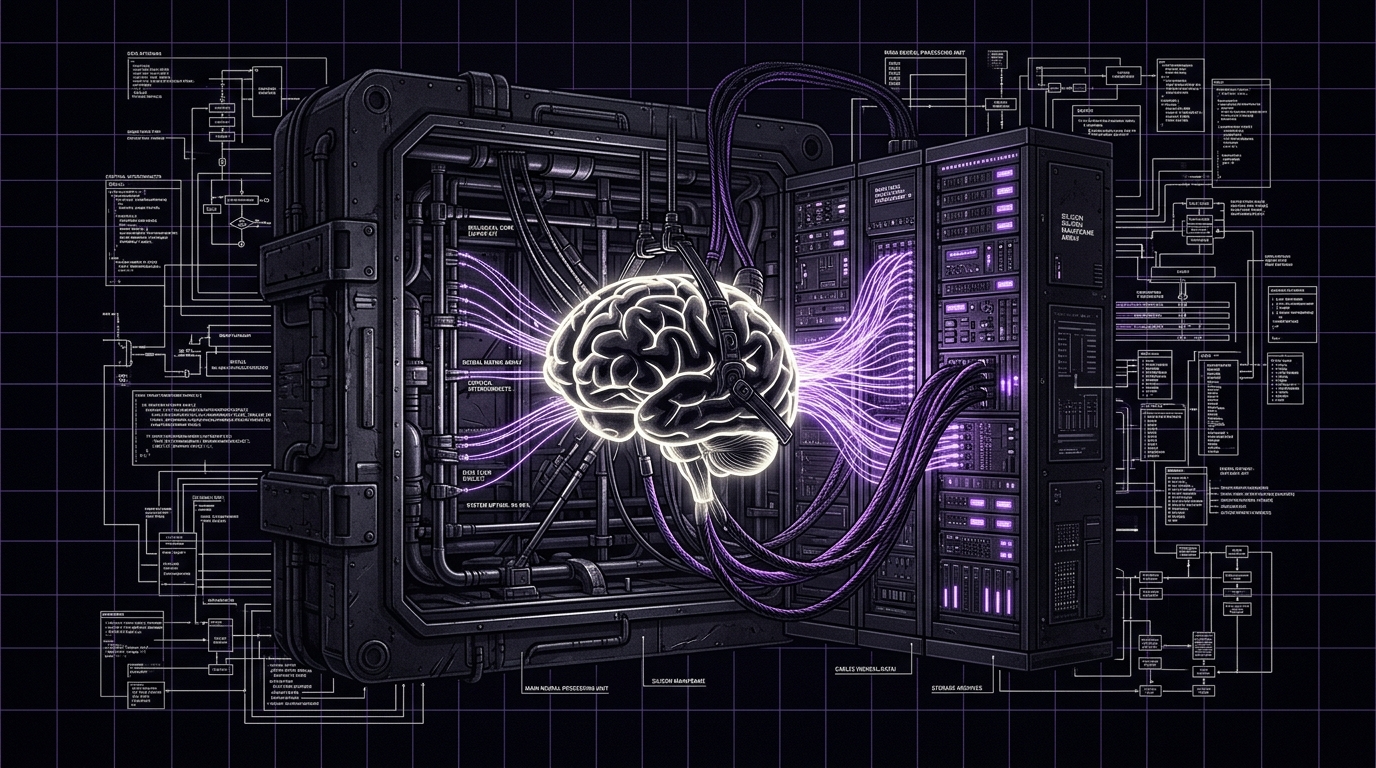
This is the hard boundary. An LLM is a phenomenal prediction machine, but it lacks the survival loop. It takes an input, runs it through layers of weights, and outputs the next token.
But it has no body. It faces no death. It has no homeostasis to maintain.
If you turn off an H100 cluster, the machine doesn’t suffer; it just stops. It has no biological reason to have a “user interface” or a subjective screen because it isn’t fighting entropy. It is a Philosophical Zombie—perfect, flawless behavior with the lights completely turned off inside.
So when we talk about creating “conscious AI,” we are making a category error. We are trying to copy the desktop icons (the intellect) without building the computer that needs them to survive (the living body).
Until a machine has to fight for its own continuous existence on a limited energy budget, experiencing the terrifying and beautiful stakes of biological survival, it will never “hallucinate” its own reality. It will remain what it has always been: a magnificent, dark mirror reflecting our own generative imagination back at us.
Row, row, row your boat, Gently down the stream, Merrily, merrily, merrily, merrily, Life is but a Dream.