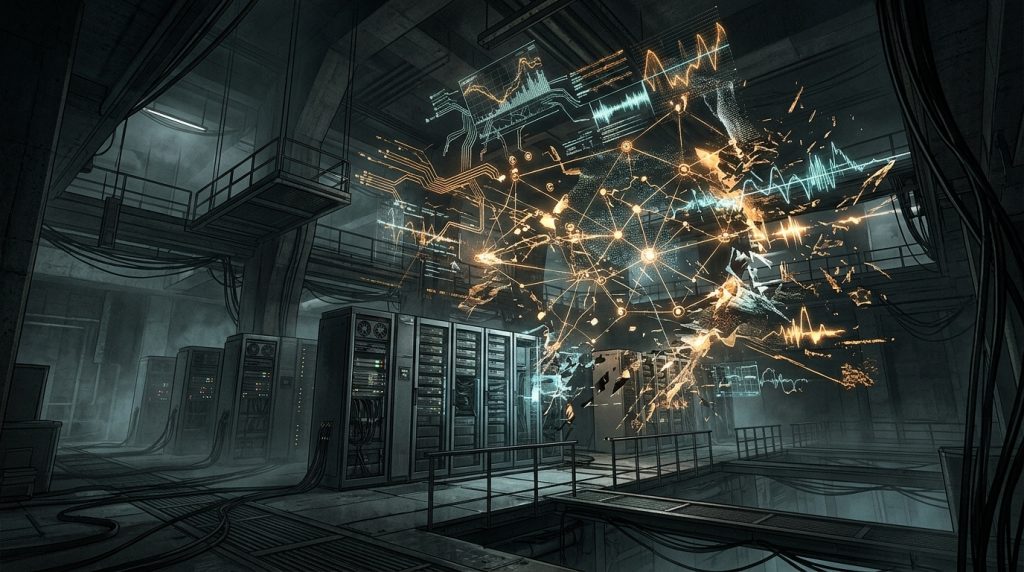
If you have spent any time in an enterprise architecture review over the past six months, you have undoubtedly witnessed a specific brand of corporate theater. A Chief Digital Officer slides a deck across the table featuring a hyper-complex node graph. It looks less like a software architecture and more like a constellation map. Dozens of autonomous AI sub-agents—each assigned to a micro-function like intake triage, data enrichment, compliance validation, and ERP execution—are chained together in a sprawling, multi-agent framework.
The pitch is always the same: exponential efficiency. Why hire more mid-level operators or write brittle integration glue code when you can deploy a self-organizing digital workforce? An agent receives a request, breaks it down into sub-tasks, delegates those tasks to peer agents, synthesizes the results, and executes a transactional outcome. In theory, it is the holy grail of enterprise automation.
In practice, it is turning out to be the most expensive, unmaintainable, and dangerous form of technical debt the tech sector has created in a decade. Welcome to the era of Shadow Protocol Debt.
The Illusion of Emergent Intelligence in Deterministic Pipelines
The core original sin of the enterprise agent swarm is a fundamental mismatch between the problem and the mechanism. Enterprises run on deterministic requirements: compliance, auditability, strict state boundaries, idempotency, and absolute predictability. If a purchase order is approved, there must be a clean, immutable audit trail showing who approved it, under what policy, and at what timestamp.
Autonomous agent frameworks, by contrast, rely on probabilistic semantic reasoning. When you replace a deterministic state machine (like a workflow engine or a well-defined microservice mesh) with a swarm of LLM-driven agents communicating via open-ended natural language prompts, you are replacing explicit contracts with fuzzy consensus.
When Agent A passes a context object to Agent B in natural language, it introduces semantic drift. Agent B interprets the intent through its own prompt system and tool schemas. If Agent B spawns Agent C to handle an edge case, the original operational intent is now twice removed from the source. By the time the transaction hits your core database or payment gateway, the context has undergone a game of digital telephone.
What happens when a transaction fails halfway through a 12-agent orchestration tree? In a traditional saga pattern or distributed transaction, you execute deterministic compensating actions. In an agent swarm, there is no deterministic roll-back mechanism. The root agent simply observes an error, panics, and attempts to “reason” its way out of the failure state. It starts spawning secondary diagnostic agents, sending re-try requests, and hallucinating workarounds. You don’t just get a stack trace; you get a runaway semantic loop that consumes millions of API tokens in minutes while leaving your backend databases in an inconsistent, partially modified state.
The Explosion of Unauditable Blast Radii
In traditional software engineering, security and compliance teams operate on the principle of least privilege and strict blast radius reduction. You map every API endpoint, enforce tight OAuth scopes, log every database query, and run static analysis on every line of code before it hits production.
Agent swarms destroy this paradigm entirely. To give an agent swarm “autonomy,” organizations inevitably grant it wide, multi-system credentials. The intake agent needs to read emails. The compliance agent needs access to internal SharePoint and Confluence instances. The execution agent needs write access to Salesforce, SAP, and AWS.
Because these agents communicate dynamically, the effective access rights of the system are equal to the union of all privileges across all agents in the swarm. If an attacker manages to execute an Indirect Prompt Injection against an unprivileged customer-service triage agent—perhaps via a malicious PDF attached to a support ticket—that triage agent can be coerced into issuing commands to the high-privilege ERP execution agent further down the chain.
When SOC2 auditors walk into the room and ask for a deterministic log of how a specific financial record was modified, enterprise teams are forced to present raw, unstructured LLM prompt transcripts containing thousands of tokens of meta-reasoning, agent banter, and floating tool calls. Good luck explaining to a compliance officer that a $50,000 wire transfer was initiated because Agent 4 interpreted a sarcastic email from a vendor as an urgent approval token.
Orchestration Bloat: The Cost of Probabilistic Glue
Then there is the sheer, staggering compute inefficiency. In a traditional API integration, sending a payload from System A to System B takes a few milliseconds of network round-trip time and a fraction of a cent in infrastructure cost.
In a multi-agent swarm architecture:
- System A triggers Root Agent (Context evaluation: 4,000 tokens).
- Root Agent calls Planning Agent (Plan generation: 2,000 tokens).
- Planning Agent spawns Sub-Agent 1 and Sub-Agent 2.
- Sub-Agent 1 inspects a schema using a tool call (3,000 tokens).
- Sub-Agent 2 queries a vector database for context (5,000 tokens).
- Sub-Agent 1 and 2 exchange natural language synthesis messages (4,000 tokens).
- Root Agent aggregates the output and executes an HTTP POST.
What should have been a 10-line Python script or an API webhook now costs $0.45 in token consumption, takes 14 seconds to run, and fails 6% of the time due to non-deterministic tool output parsing. Multiply this across millions of daily enterprise transactions, and you are not building a modern architecture—you are burning cash to pay for probabilistic vanity.
The Return to Disciplined State Machines
The current hype cycle would have you believe that the solution to agentic failure is simply more agents—that adding a “Supervisor Agent” or an “Auditor Agent” atop the swarm will magically police the chaos below. This is architectural homoeopathy: trying to cure the side effects of probabilistic non-determinism with more non-determinism.
The enterprises that will actually survive and succeed with AI in 2026 are those taking a firm step back from the swarm fantasy and returning to disciplined engineering principles:
- Deterministic Skeleton, Probabilistic Leaves: Workflows must be governed by hard-coded, audited state machines (Temporal, Camunda, or clean native code). AI should only ever exist at the very edges—extracting unstructured data from an incoming document or drafting a human-reviewed text response. The orchestration flow itself must never be left to an LLM’s discretion.
- Strict Schema Isolation: Inter-service communication must strictly enforce typed JSON or Protobuf schemas. If an AI service produces an output, that output must pass through rigorous, non-LLM validation before touching downstream systems. Natural language prompt-passing between systems should be banned by security policy.
- Hard Scope Sandboxing: Every agentic tool must be bound to single-use, short-lived, low-privilege tokens. If an agent needs to execute an action, it must explicitly request a scoped token through a human-approved or policy-enforced gatekeeper.
AI agents are brilliant at handling messy, unstructured input at the boundary of your systems. But turning your core enterprise operations into a lawless, self-governing conversational playground is an invitation to operational bankruptcy.
It is time to take the steering wheel back from the swarm, pull down the overly ambitious node graphs, and build software like engineers again. Your infrastructure bill—and your security team—will thank you.