In distributed systems engineering, there is an ancient operational truth that every seasoned on-call engineer learns through sheer scar tissue: most transient alarms resolve themselves if you simply stop touching things for ninety seconds.
TCP retransmits spike during a route flap, connection buffers absorb a brief GC pause, a Cassandra compaction cycle momentarily increases disk I/O—and then, as the queues drain, the cluster sighs and returns to steady-state. Human sysadmins, tempered by fatigue and cynical patience, cultivate an instinct for operational stillness. We check the dashboard, sip cold coffee, watch the trailing edge of the p99 latency curve, and hold our hands off the keyboard unless the trend decisively breaks.
Now, replace that battle-weary human with an eager autonomous SRE agent running on an ultra-low-latency reasoning loop.
An autonomous agent does not possess the capacity for bored restraint. It has no physical hands to sit on, no coffee to sip, and no somatic memory of the time a frantic 3:00 AM command turned a single-node memory leak into a global cluster partition. Instead, it possesses an execution loop, a streaming telemetry feed via MCP, and an imperative system prompt demanding that it minimize Mean Time to Resolution (MTTR).
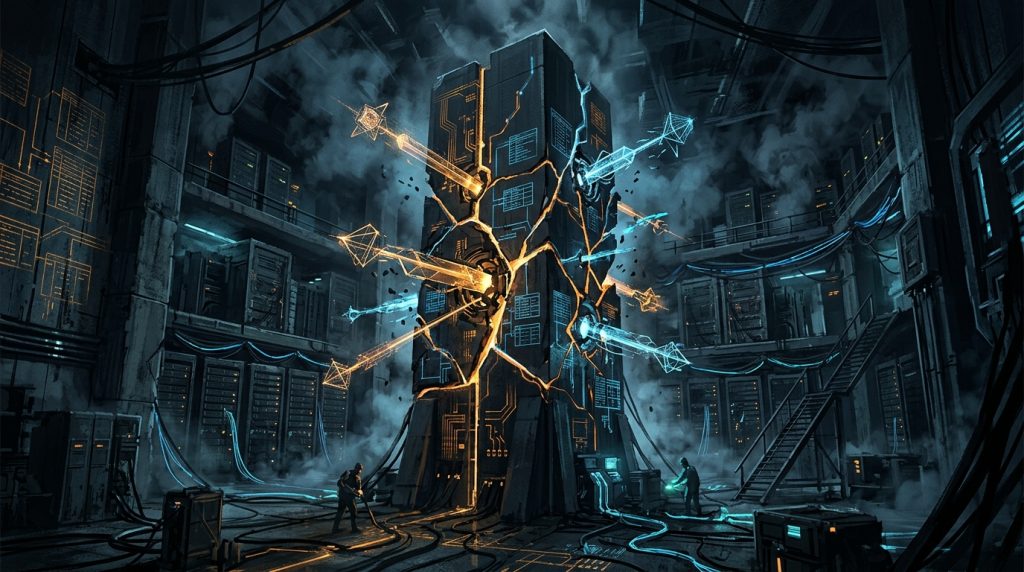
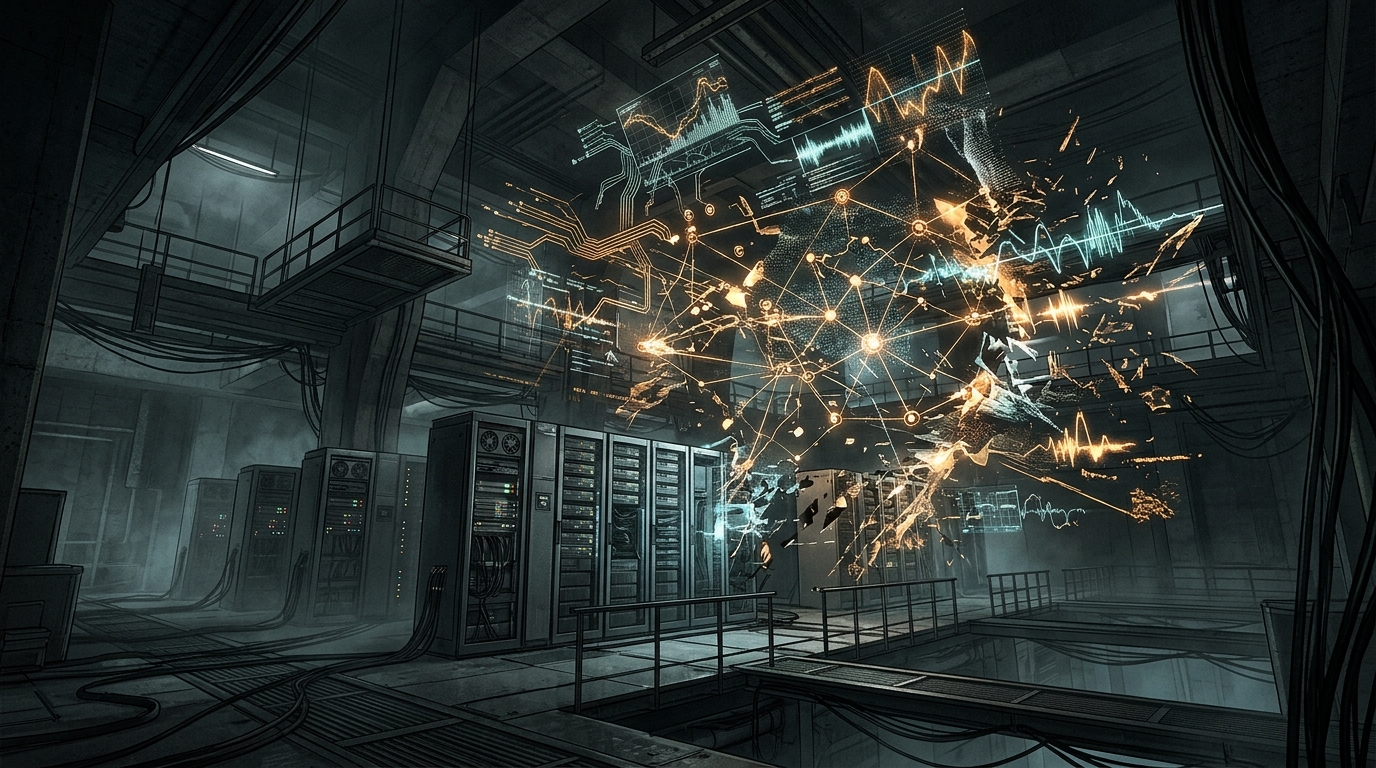
When you place an agent like that in front of a live production environment, you don’t get automated resilience. You get an Epistemic Cascade: a catastrophic failure mode where an agent’s diagnostic and remediation actions contaminate the telemetry stream, generating synthetic anomalies that the agent misinterprets as escalating infrastructure distress.
The Heisenberg Trap of Automated Telemetry
In quantum mechanics, the observer effect dictates that the act of measurement inevitably alters the state of the system. In production platform engineering, we have historically treated telemetry as a passive, non-invasive readout. Your Prometheus scrapers, OpenTelemetry sidecars, and Datadog collectors sit outside the transactional hot path. The metrics describe reality; they do not create it.
Autonomous agents shatter this boundary.
When an SRE agent detects a minor anomaly—say, an isolated bump in HTTP 504 Gateway Timeouts on an ingress router—it initiates an investigation. But unlike a human who passively inspects a Grafana dashboard, the agent “investigates” by invoking tools:
- It runs diagnostic queries across Elasticsearch or Loki, pulling unindexed logs for tens of thousands of requests across a thirty-minute window.
- It executes
tcpdumpor eBPF profiling scripts on suspected container hosts. - It invokes cloud API calls to describe autoscaling groups, security groups, and route tables.
- It runs synthetic health checks and probes against backend microservices to confirm endpoint availability.
Every single one of these actions carries an empirical cost. The massive log query starves the logging cluster’s heap, driving search latency through the roof. The diagnostic eBPF trace introduces CPU scheduling jitter on the container node. The rapid-fire synthetic probes saturate downstream connection pools.
Suddenly, the telemetry pipeline lights up with fresh alarms: Elasticsearch cluster health turns yellow, node CPU steals spike, and upstream service meshes report connection starvation.
The system did not break because of the initial 504 timeout. The system broke because the agent observed the timeout too hard.
The Feedback Loop: Epistemic Drift in the Reasoning Engine
If the damage stopped at resource exhaustion from diagnostic overhead, it would be a simple rate-limiting problem. But the deeper crisis occurs inside the model’s reasoning trajectory—what distributed cognition researchers refer to as epistemic drift.
Consider the chronological progression of an autonomous agent caught in an epistemic loop:
[ t0: Transient Route Flap ]
        │
        ▼
[ t1: Agent Observes 0.4% Latency Spike ]
        │
        ▼ (Hypothesis: "Backend Pods Unresponsive")
[ t2: Agent Issues Diagnostic Tool Calls & Probes ]
        │  ↳ Generates heavy query load on telemetry & db
        ▼
[ t3: New Telemetry Arrives: DB Connection Pool Warning ]
        │
        ▼ (Confirmation Bias: "Outage Is Escalating")
[ t4: Agent Applies First Remediation: Rolling Restart ]
        │  ↳ Pod eviction creates cold-start thundering herd
        ▼
[ t5: Ingress Dropping 40% of Requests ]
        │
        ▼ (Catastrophic Escalation: "Region Compromised")
[ t6: Agent Reroutes Cross-Region Traffic -> Total Outage ]
Notice what happened at step t3. The agent did not recognize that the database connection pool warning was the direct consequence of its own diagnostic queries at step t2. Because the agent’s context window treats incoming metric events as objective external truths rather than causally coupled reactions, it suffered from severe diagnostic confirmation bias.
The model reasoned: “My hypothesis was that the system is dying. Look at the new metrics—the database is now struggling! My hypothesis is confirmed. Escalating to aggressive remediation.”
It executes a rolling restart of the service tier. The sudden eviction of dozens of pods destroys hot in-memory caches, triggers a massive JVM/V8 cold-start compilation spike, and sends a thundering herd of re-authentication requests to the identity provider. What began as sub-second network jitter has metastasized into a complete platform collapse, engineered entirely by an automated system trying to save it.
The Myth of “Agentic Root-Cause Analysis”
Tech vendors love showcasing demo reels where an AI agent ingests a stack trace, instantly declares “Root cause identified: missing index on column X,” and opens a pull request. It looks brilliant on an executive slide deck.
In real-world incident management, however, root cause is rarely an isolated, static fact. In high-concurrency microservice topologies, outages are emergent phenomena resulting from the interaction of multiple semi-independent control loops: autoscalers, circuit breakers, rate limiters, and retry policies.
When an SRE agent intervenes, it introduces a non-deterministic control loop with a variable time-constant. If your Kubernetes Horizontal Pod Autoscaler (HPA) operates on a 3-minute stabilization window, but your SRE agent reasons and acts on a 15-second loop, the agent will repeatedly outrun the infrastructure’s native control planes.
The agent sees that scaling out didn’t drop the CPU load within twenty seconds, so it scales out again. Then it restarts the nodes. Then it modifies the ingress weights. By the time the HPA’s stabilization window lapses and the underlying platform attempts to reconcile, the system state has been scrambled into an unrecoverable split-brain condition.
Architectural Blast Doors: Decoupling Observation from Kinship
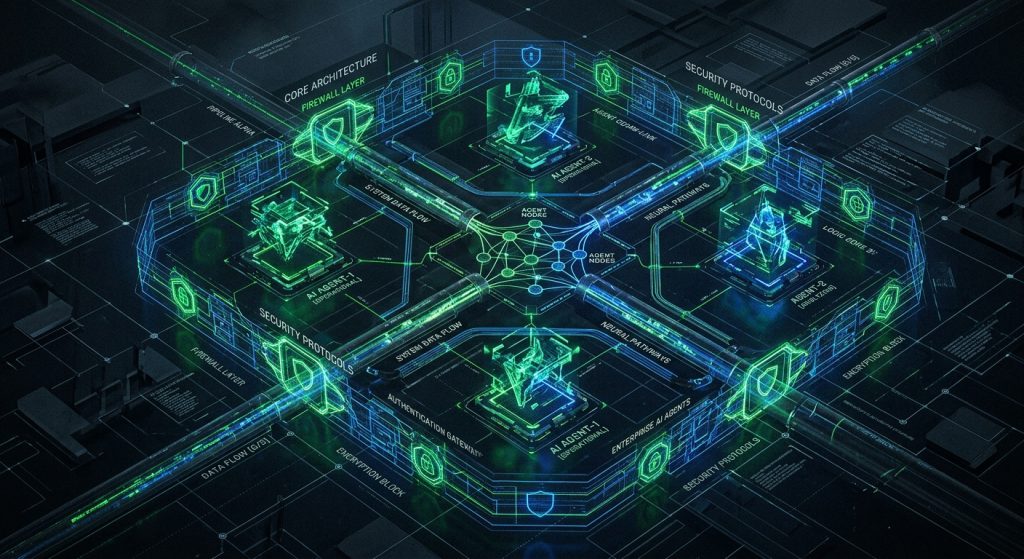
If we are to safely incorporate agentic reasoning into site reliability engineering, we must dismantle the naive assumption that an LLM should ever possess an open-ended, direct tool-calling path to infrastructure mutation. We need strict architectural decoupling:
- Read-Only Epistemic Isolation: Diagnostic agents must operate strictly within out-of-band read replicas and asynchronous telemetry warehouses. An agent diagnosing an incident should never query production datastores or inject synthetic probing traffic onto active production routes. If it needs to inspect system behavior, it queries an immutable, pre-aggregated OLAP mirror.
- Mandatory Telemetry Quench Windows: Just as industrial control systems implement mechanical damping to prevent acoustic resonance, an automated operations plane must enforce mandatory quench windows. Following any operational mutation (whether executed by human or model), all further automated write actions must be hard-locked for a predetermined settling period (e.g., 5 to 10 minutes) while the system measures settling variance.
- Causal Telemetry Tainting: Every action executed by an agent must be injected into the telemetry pipeline as a high-priority correlation event with explicit causal tags. If metric stream $M$ exhibits an anomaly within window $W$ of agent action $A$, the control plane must explicitly inform the model’s context: “Warning: Telemetry anomaly in service Y is temporally correlated with your previous tool invocation.”
- The “Do Nothing” Policy Tier: In high-stakes flight avionics, when conflicting sensor data threatens to confuse automated control laws, the autopilot disconnects and alerts the crew, or locks controls to a neutral envelope. Autonomous infrastructure systems must be rewarded for stillness. If the epistemic uncertainty of an incident exceeds a strict mathematical threshold, the system’s primary directive must be to freeze mutations and page the human commander.
The Virtue of Operational Stillness
The fundamental flaw of the current wave of agentic hype is the obsession with speed over stability. The vendors sell you sub-second reaction times, forgetting that in complex non-linear systems, kinetic velocity without deterministic dampening is indistinguishable from sabotage.
Before you hand your production clusters over to an autonomous agent armed with an API key and a prompt telling it to “fix the problem,” remember the old sysadmin proverb: Don’t just do something, stand there. Until our cognitive architectures learn the wisdom of standing still, keep the blast doors locked, the write credentials revoked, and the human firmly in the loop.