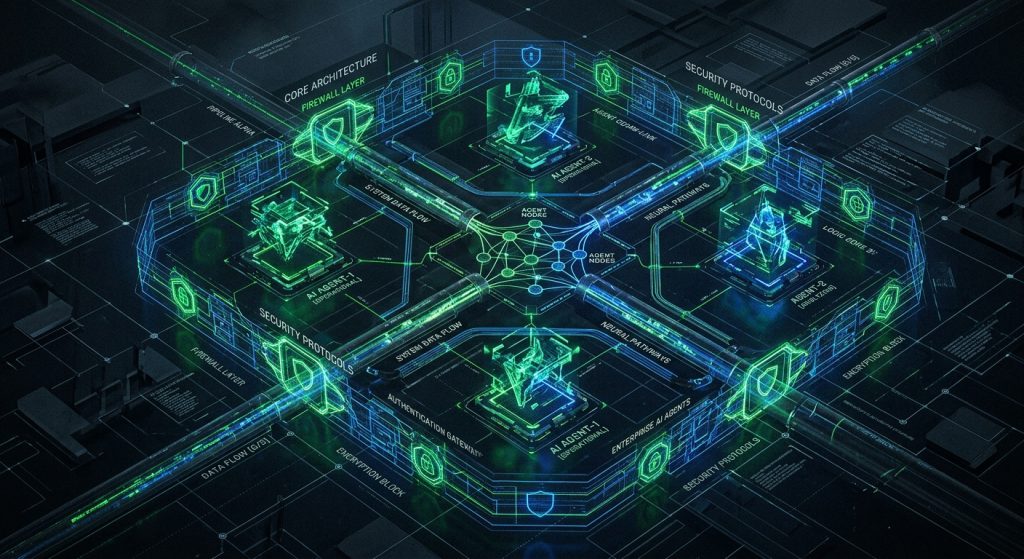
Over the last few months, the industry narrative has undergone a quiet, desperate pivot. The initial dream was simple: give large reasoning models an execution loop, grant them MCP server access, and watch them autonomously orchestrate the entire enterprise stack. But as engineering teams quickly learned in the trenches of incident triage, unconstrained autonomous agents in production don’t just fix bugs—they compress minor telemetry noise into multi-region cascading blackouts.
To patch the bleeding, the platform engineering zeitgeist converged on control planes: policy interceptors, token-bucket mutation limits, and GitOps blast doors. If the agent can’t blindly mutate Kubernetes deployments or hammer cloud provider APIs directly, the infrastructure survives.
Except we left the front door wide open in the basement.
While platform teams spent late summer wrapping infrastructure in deterministic harnesses, product teams were busy granting agent swarms direct connection pools into the lifeblood of the enterprise: the relational database. In boardrooms and demo reels, it sounds intoxicatingly modern: “Just give the model natural language schema access! Let the agent autonomously query, reconcile, and mutate transactional state!”
It’s time to call this what it actually is: an architectural suicide pact. Agentic AI systems do not merely stress databases; they violate the fundamental, half-century-old mathematical assumptions upon which relational database engines were conceived.
The Unspoken Contract of Relational Engines
Every relational engine powering modern commerce—from Postgres and MySQL to Spanner and Aurora—is an intricate, mechanical cathedral optimized around an unspoken contract between application developers and storage engines. That contract rests on four implicit invariants:
- Locality and Path Determinism: Queries follow bounded, statically analyzable execution paths. Even in dynamic applications, the query planner operates over parameterized statements whose access shapes, join graphs, and index footprints are known and pre-warmed.
- Bounded Concurrency Windows: Transactions are engineered to be microscopic. A human or deterministic script opens a transaction, mutates indexed rows in milliseconds, releases write locks, and commits. The engine’s Multi-Version Concurrency Control (MVCC) and lock managers are calibrated for throughput, not patience.
- Monotonic Schema Stability: The data catalog is immutable at runtime. Schema migrations are rare, deliberate, and decoupled from application request cycles. The system catalogs (
pg_class,information_schema) exist to serve the planner, not to act as unstructured RAG context for a model running in an interactive loop. - Deterministic Semantic Intent: A write statement carries explicit, unambiguous programmatic purpose. The database does not need to deduce why a foreign key is being modified; the application layer guarantees that the business domain logic has already evaluated the state transition.
Autonomous LLM agents take every single one of these invariants, douse them in kerosene, and toss a match.
Pathological Access: The Cartesian Drift of Exploratory Queries
Consider what happens when an autonomous agent is tasked with a mundane operational goal—say, “reconcile unbilled partner accounts from last quarter.”
A deterministic software engineer writes a tailored, indexed query, tests the EXPLAIN ANALYZE in staging, and packages it behind a microservice API. An autonomous agent, armed with a SQL tool or an open-ended database driver, behaves like a caffeinated junior analyst with infinite compute and zero fear of god.
The agent inspects the system catalog. It synthesizes SQL on the fly. When its first query fails to return the expected shape, it doesn’t stop—it iterates. It injects exploratory joins across unindexed text fields. It writes correlated subqueries across millions of unpartitioned audit logs. It constructs Cartesian products in memory because its attention mechanism hallucinated a foreign key relationship that does not exist.
In thirty seconds, an unthrottled agent can blow out the shared buffer cache, evict hot working sets into disk I/O, lock up sequential scan pipelines, and starve latency-critical transactional workloads. The database optimizer, built over decades to predict statistical selectivity across structured access paths, is forced to referee pathological, non-convergent SQL vomit generated by a probabilistic token generator.
The Transactional Stare: MVCC Bloat and Zombie Locks
The second fatal collision occurs inside transaction boundaries.
In traditional OLTP architectures, transactions are treated like hot radioactive cores: you hold them for single-digit milliseconds and drop them. But agentic reasoning loops operate on human-scale clock ticks. An agent opens a transaction, executes an exploratory SELECT ... FOR UPDATE, and then… pauses. It ships the intermediate result set across the network to an LLM provider. It waits 1,200ms for inference. It reasons through a multi-step planning tree. It calls an external vector search tool. It debates its next step.
Meanwhile, inside the database engine, the clock is ticking:
- Lock Contention: Row and table-level locks remain pinned, backing up connection pools across the entire cluster.
- MVCC Table Bloat: In PostgreSQL, autovacuum cannot clean up dead tuples newer than the oldest active transaction snapshot. An agent lingering on an open transaction for sixty seconds freezes vacuuming across the entire cluster, causing table bloat to skyrocket and index lookup latency to degrade for every production service.
- Connection Pool Starvation: Agents holding persistent sessions while idling on external API calls exhaust connection limits (PgBouncer/RDS Proxy), precipitating synthetic connection timeouts across unrelated downstream microservices.
Relational storage layers were simply never engineered to accommodate conversational latency inside transaction lifecycles.
The “Vibe Coding” Delusion: Why Backups Won’t Save You
In developer forums, the apologists love to dismiss this with a wave of the hand: “Just give the agent write access! Small businesses run on messy spreadsheets anyway. If something breaks, we have automated backups and point-in-time recovery (PITR)!”
This is the battle cry of someone who has never been paged at 3:15 AM to resolve split-brain data corruption across a multi-terabyte production datastore.
Point-in-time recovery is a catastrophic disaster recovery tool, not an operational retry loop. Rolling back a production database by twenty minutes to undo an agent’s rogue schema or row mutation means discarding hundreds of legitimate customer orders, dropping concurrent payment receipts, and triggering asynchronous webhook chaos across your entire third-party ecosystem. Data is stateful; you cannot git revert reality without collateral carnage.
Furthermore, when an agent mutates data based on probabilistic reasoning, the corruption is rarely loud. It doesn’t drop the table. Instead, it subtly adjusts balance fields, misallocates billing credits, or fabricates foreign-key linkages that satisfy its internal prompt constraints while silently violating implicit business domain rules. By the time a human notices the discrepancy weeks later, the corrupted state has metastasized across replicas, downstream data warehouses, and financial ledgers.
The Architectural Antidote: Mediated Memory and Intent Contracts
If we are going to integrate autonomous cognitive agents into transactional enterprise architectures, we must stop pretending they are trusted database users. The rule must be mathematically absolute: An AI model must never hold direct credentials to a production database, nor should it ever construct raw SQL strings against an operational catalog.
The path forward demands strict architectural decoupling:
- Intent-Based Semantic APIs: Agents should interact with state exclusively through strongly-typed, idempotent service contracts (gRPC/REST) or stored domain procedures. An agent does not execute
UPDATE accounts SET balance = ...; it requests a signed intent:DisputeBillingAdjustment(account_id, amount, reason). The API layer enforces validation, business invariants, and rate limiting deterministically. - Copy-on-Write Ephemeral Sandboxes: If an agent requires exploratory SQL analysis for diagnostic or reporting workflows, it must be provisioned an ephemeral, sanitized database branch using copy-on-write storage (via technologies like Neon or Xata). Let the model run its Cartesian joins in an isolated sandbox where buffer pool destruction and table lock deadlocks die when the container terminates.
- Out-of-Band Audit Attestation: Every mutation triggered by an agentic intent must be cryptographically tagged with its causal lineage—model version, input prompt hash, policy evaluation receipt, and human-in-the-loop authorization token. In regulated industries, the dilution of responsibility isn’t just bad engineering; it’s an existential compliance liability.
State is Forever. Model Weights are Fleeting.
Code is cheap to throw away; compute is a commodity; context windows refresh with every API call. But your database is the immutable physical ledger of your company’s reality. It contains the promises you made to your customers, the balances you owe, and the historical truth of your business.
Surrendering that ledger to probabilistic token completion because someone wanted to demo an “autonomous data analyst” is architectural malpractice. Put the blast doors on your databases. Lock down the connection pools. If an agent wants to talk to production state, force it to knock on the door of a deterministic API—and make sure the deadbolt is thrown.