Earlier this month, in The Autonomy Paradox, I argued that deploying autonomous SRE agents with direct mutating access to production infrastructure creates a catastrophic new failure domain: positive feedback cascades that compress minor telemetry hiccups into total platform collapse. The conclusion was straightforward—prompt instructions and static command allowlists are not architectural boundaries.
The obvious follow-up question I’ve heard from engineering leads since then is: If prompts and allowlists can’t secure cognitive agents, what does the actual reference architecture look like?
Today, we’re putting the philosophical critiques aside and stepping into the engine room. If you intend to let autonomous or semi-autonomous models execute actions across Kubernetes clusters, cloud APIs, and service meshes, you need a Deterministic Control Plane (DCP). Here is the concrete architectural blueprint for building the blast doors.
The Architectural Topology: Never Let an Agent Talk Direct to the API
The foundational mistake in current SRE agent implementations is the direct wiring of the Model Context Protocol (MCP) or tool-calling runtime to cloud control planes. The agent gets a kubeconfig or an IAM role with write permissions, reasons over an alert, and fires a mutating API call directly at the Kubernetes API server or cloud provider endpoint.
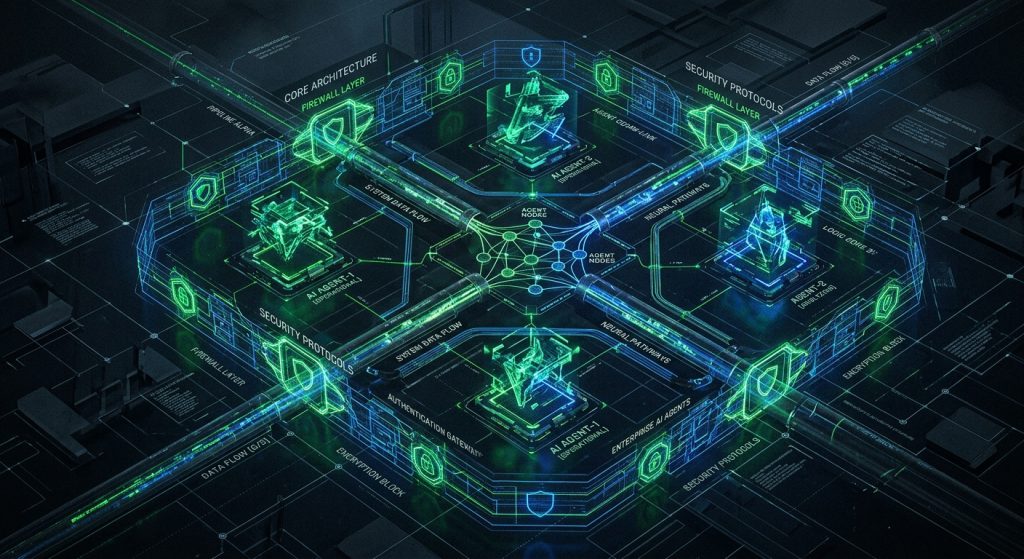
In a hardened DCP architecture, the agent has zero direct network ingress to production control planes. Every mutating tool call is treated as an untrusted, unverified intent payload routed through a three-stage mechanical interceptor:
[ Agent Telemetry Loop ]
         │
         ▼ (Proposes Mutating Action)
┌─────────────────────────────────────────────────────────────┐
│               DETERMINISTIC CONTROL PLANE                   │
│                                                             │
│  1. Invariant Policy Gate (OPA / Cedar via WASM)            │
│  2. Token Bucket System Entropy Budget                      │
│  3. Shadow Verification Sandbox (Ephemeral Digital Twin)   │
└─────────────────────────────────────────────────────────────┘
         │
         ▼ (Cryptographically Signed Ticket)
[ Production Ingress / GitOps Reconciliation Engine ]
Stage 1: Invariant Policy Engine (Decoupling Policy from Context)
When an agent decides to act—for instance, patching a deployment to increase replica count, cycling an ingress controller, or modifying connection pool limits—the payload is first submitted to a stateless policy evaluator running Open Policy Agent (OPA) or Cedar compiled to WebAssembly.
Unlike an LLM whose attention fluctuates based on token density, the policy engine enforces mathematically immutable system invariants:
- Topology Constraints: An agent may never mutate more than 20% of a stateless tier’s capacity simultaneously.
- Stateful Freeze Invariants: If a primary or replica database reports replication lag > 500ms or disk utilization > 85%, any mutating action targeting upstream connection pools or backend services is hard-rejected at the wire level.
- Blast Radius Boundaries: Single-tenant or single-region agents are cryptographically forbidden from submitting actions that touch cross-region routing tables or global mesh configurations.
If the proposed action violates a single system invariant, the request is immediately dropped with a structured error returned to the agent’s context window: ERR_INVARIANT_VIOLATION. The agent is forced to re-evaluate its operational hypothesis without production ever feeling the tremor.
Stage 2: The System Entropy Budget (Mechanical Rate Limiting)
In distributed systems under distress, action velocity is poison. When an SRE agent encounters a flapping network route or an intermittent database lock, its instinct is to iterate: retry, restart, scale, restart again. In ninety seconds, an unthrottled agent can inject enough kinetic mutation into a cluster to exhaust IP pools and crash DNS resolvers.
The DCP enforces a System Entropy Budget via distributed token buckets keyed to failure domains:
- Cluster-Wide Mutation Rate: A global rate limiter allows a maximum of N state-mutating operations per 10-minute sliding window across the entire cluster.
- Cool-Down Hysteresis: Following any mutating action (e.g., rolling restart or horizontal scale-out), the DCP imposes a mandatory stabilization lock (e.g., 180 seconds) during which telemetry must demonstrate a return to steady-state before subsequent mutations targeting the same namespace are permitted.
- Entropy Exhaustion Circuit Breaker: If an agent consumes its entire entropy budget without achieving a reduction in error rate, the DCP trips a hardware-style circuit breaker. The agent is stripped of execution tokens and automatically demoted to read-only diagnostic reporting while simultaneously paging the human incident commander.
Stage 3: Ephemeral Shadow Verification (Testing in the Mirage)
For high-risk operations—modifying routing topology, resizing critical datastores, or changing global rate-limiting thresholds—direct execution is unacceptable regardless of model confidence.
Instead, the DCP spins up an ephemeral, sanitized shadow sandbox (a lightweight digital twin using isolated namespace clones or eBPF-routed traffic mirroring):
- The agent’s remediation script is applied strictly inside the shadow environment.
- Synthetic load or mirrored production telemetry is piped through the sandbox for 30 seconds.
- If the sandbox metrics demonstrate verified recovery without secondary resource starvation (e.g., memory spikes, DNS drops, connection pool exhaustion), the DCP generates a cryptographically signed Execution Ticket.
This ticket is handed to a GitOps engine (like ArgoCD or Flux) or queued for single-click human authorization depending on the blast-radius classification.
Stop Writing Prompts. Start Writing Control Systems.
The era of treating LLMs as magical, autonomous sysadmins who can be safely constrained by polite system prompts is over. Large reasoning models are incredible diagnostic amplifiers—they can ingest tens of thousands of unstructured log lines, synthesize complex stack traces, and correlate disparate telemetry streams faster than any human engineer.
But when it comes to mutating production state, they are probabilistic execution engines that require rigorous mechanical containment. Building the blast doors isn’t about neutering AI autonomy—it’s about giving our infrastructure the deterministic armor it needs so that when the agent is wrong, production stays up.