Over the past twelve months, the engineering discourse surrounding agentic AI has fixated heavily on interface expansion. The prevailing industry dogma assumes that if an LLM is given enough tools—standardized Model Context Protocol (MCP) servers, OpenAPI specifications dynamically scraped into system prompts, and rich execution sandboxes—it can effectively navigate arbitrary corporate software estates. The enterprise sales pitch is enticingly simple: define your tool schemas in JSON, expose your REST endpoints, hand the agent an API token, and let autonomous workflows execute complex multi-step tasks end-to-end.
Yet as multi-agent pipelines move from sanitized demos into noisy production environments, a pervasive, insidious operational failure mode has begun to surface. It rarely presents as a hard crash, an HTTP 500 error, or an explicit validation rejection. Instead, it manifests as silent data corruption, distorted business logic, and ghost state mutations across downstream datastores.
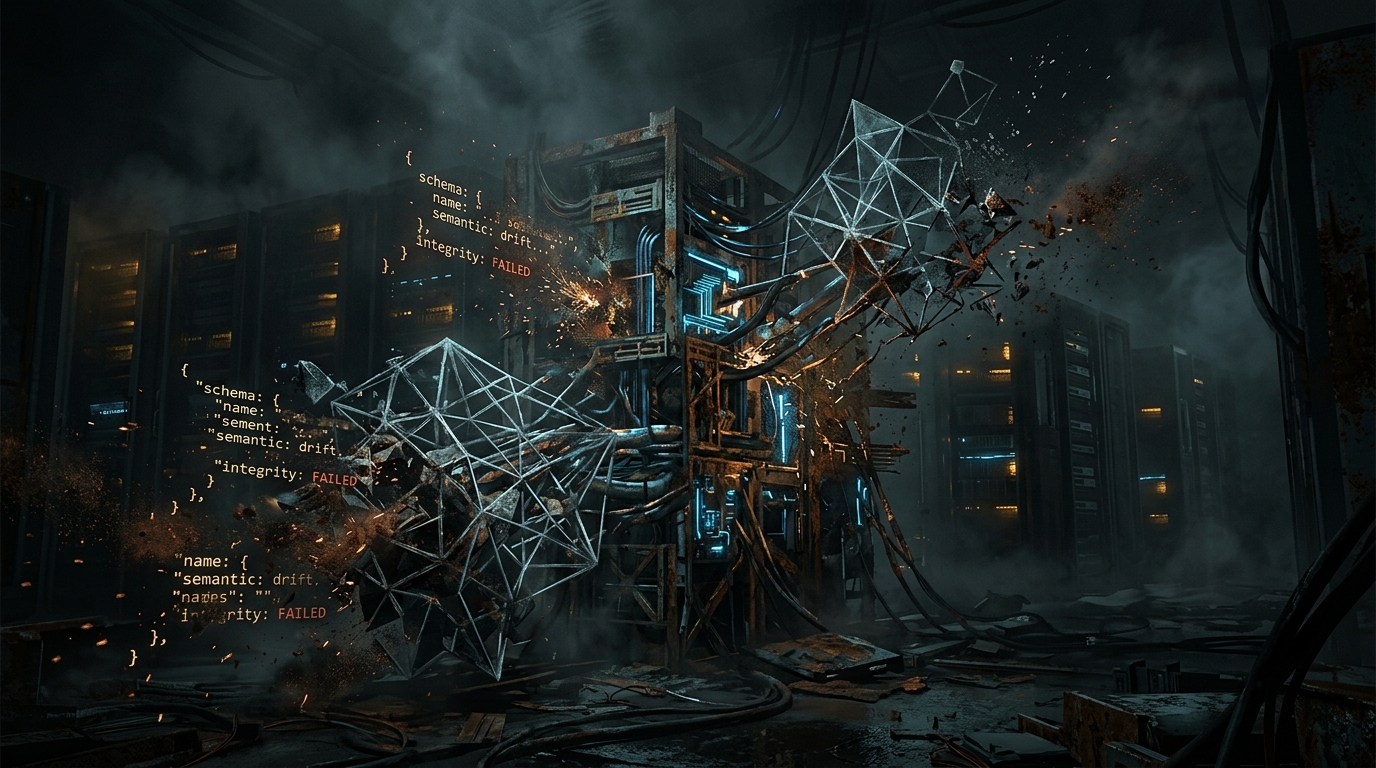
This is the reality of Semantic Drift and Schema Decay: the hidden operational tax of expecting probabilistic models to execute deterministic operations against living, shifting software interfaces.
1. The Illusion of Typed Invariants
Software engineering spent four decades building static typing, formal interface definition languages (IDLs), and immutable API contracts precisely because human developers are notoriously unreliable at preserving behavioral assumptions over time. A protobuf schema or an OpenAPI JSON specification does not merely declare field names; it represents a hard boundary of system invariants.
When an LLM interacts with a tool ecosystem, however, those structural boundaries soften into statistical suggestions. An agent does not parse a JSON Schema the way a compiler does; it ingests the schema as tokens in an attention matrix, calculating probability distributions over potential function arguments.
In clean benchmark scenarios, this abstraction holds up remarkably well. But in the messy reality of enterprise microservices, API contracts are fraught with unwritten, contextual assumptions:
- An argument named
timeout_msexpects a positive integer, but the underlying service silently treats0as ‘block indefinitely’ rather than ‘fail immediately’. - A boolean parameter named
dry_rundefaults tofalsein the backend implementation, yet the agent’s internalized training priors assume modern deployment tools default to safe, non-mutating preview modes. - A pagination cursor is documented as an opaque string, but the downstream service expects base64-encoded UTC timestamps formatted to microsecond precision.
When an agent misinterprets these implicit contracts, it does not throw a syntax error. It synthesizes structurally valid, schema-compliant JSON payloads that satisfy the parser while completely violating the underlying domain logic. The request succeeds over the wire, but the semantic outcome is catastrophic.
2. Schema Decay: The Living API Problem
Software systems are not museum artifacts; they are living codebases subject to continuous deployment, incremental refactoring, and emergency hotfixes. In traditional distributed architectures, client SDKs and upstream services are protected from breaking changes through strict versioning, deprecation windows, and compile-time verification.
In agentic ecosystems, tool specifications are frequently updated dynamically at runtime via registry discovery. When a backend engineering team makes an ostensibly ‘non-breaking’ semantic tweak to an endpoint—such as modifying the behavioral semantics of an optional enum, altering the sorting default of a query endpoint, or adjusting rate-limiting backoff signals—human consumers adapt through documentation updates and release notes.
To an autonomous agent, however, this creates immediate Schema Decay. The agent’s parametric knowledge—and the fine-tuned task prompts directing it—were conditioned on historical behavior. When the operational semantics of the tool shift beneath the agent’s feet without a corresponding break in the syntactic schema, the agent experiences severe semantic confusion.
It continues invoking the tool with confidence, relying on stale assumptions about side effects and state transitions. By the time telemetry alarms flag an issue, the agent has already executed dozens of downstream dependent tasks based on invalidated intermediate assumptions.
3. The Explosive Combinatorics of Tool-Chaining
The danger of semantic drift escalates exponentially when agents operate in deep execution chains. In single-turn function calling, a human or a deterministic validation layer can easily inspect and sanitize tool arguments. But modern agentic architectures depend on long-horizon, autonomous multi-step execution—where the output of Tool A becomes the context for Tool B, which formats the input for Tool C.
Consider a standard automated infrastructure provisioning pipeline:
- Step 1 (Discovery): The agent queries an asset registry tool to find unallocated subnets in a cloud VPC. The tool returns a list of CIDR blocks, but due to an unannounced backend patch, the list includes reserved peering blocks flagged only by an obscure metadata attribute.
- Step 2 (Analysis): The agent misreads the metadata attribute as an arbitrary tag rather than a reservation lock and selects an active peering subnet.
- Step 3 (Configuration): The agent feeds the conflicting subnet into a security group provisioning tool, which accepts the string without cross-validating peering constraints.
- Step 4 (Mutation): The agent deploys new routing table rules, overwriting core transit routes and severing inter-region database replication.
At no point in this sequence did an API return an error. Every schema was valid. Every tool invocation matched its JSON specification. Yet the entire operation resulted in a severe P0 production incident due to a compound semantic error propagating silently across four separate tool boundaries.
4. Architectural Antidotes: Hardening the Agentic Perimeter
If we want to build reliable, high-autonomy systems without succumbing to schema decay and semantic drift, engineering teams must abandon naive direct-to-API agent patterns. Production-grade agent architectures require rigorous, deterministic structural boundaries:
- Deterministic Intermediary Facades: Never expose raw REST or gRPC APIs directly to LLMs. Wrap your systems in tightly scoped, idempotent task-specific facades. A tool should not be
updateDatabaseRow(); it should beallocateStagingSubnetWithPreflightCheck(). The domain validation logic must live in deterministic code, not in the prompt. - Runtime Pre-Flight Simulation: For any mutating action, the tool boundary must support and enforce an authoritative dry-run simulation that evaluates side effects against the live system state before execution. If the simulation detects anomalous state deltas, the execution must abort to human review.
- Continuous Synthetic Contract Testing: Treat tool schemas as critical test surfaces. Implement continuous evaluation suites that submit adversarial, ambiguous, and edge-case prompts to agents across all registered tool schemas, asserting that the generated invocations strictly adhere to domain invariants.
- Strict State Rollback Primitives: Every tool with side effects must implement a corresponding rollback or compensation primitive. If step four of an eight-step autonomous sequence fails or diverges from expected invariant checks, the system must deterministically unwind all prior mutations rather than allowing the agent to attempt chaotic, on-the-fly conversational remediation.
The Real Measure of Autonomy
The true benchmark of an agentic system is not how many hundreds of tools it can juggle in a demo video; it is how reliably it respects the invariant laws of the software environment it inhabits. Tools are not magic wands—they are high-voltage power lines hooked directly into production datastores.
Until we treat agentic tool-calling with the same rigorous engineering discipline, deterministic validation, and contract hygiene that we demand of mission-critical distributed systems, autonomous agents will remain what they are today: brilliantly fast catalysts for unprecedented operational chaos.